
Buy anything from 5,000+ international stores. One checkout price. No surprise fees. Join 2M+ shoppers on Desertcart.
Desertcart purchases this item on your behalf and handles shipping, customs, and support to Kyrgyzstan.
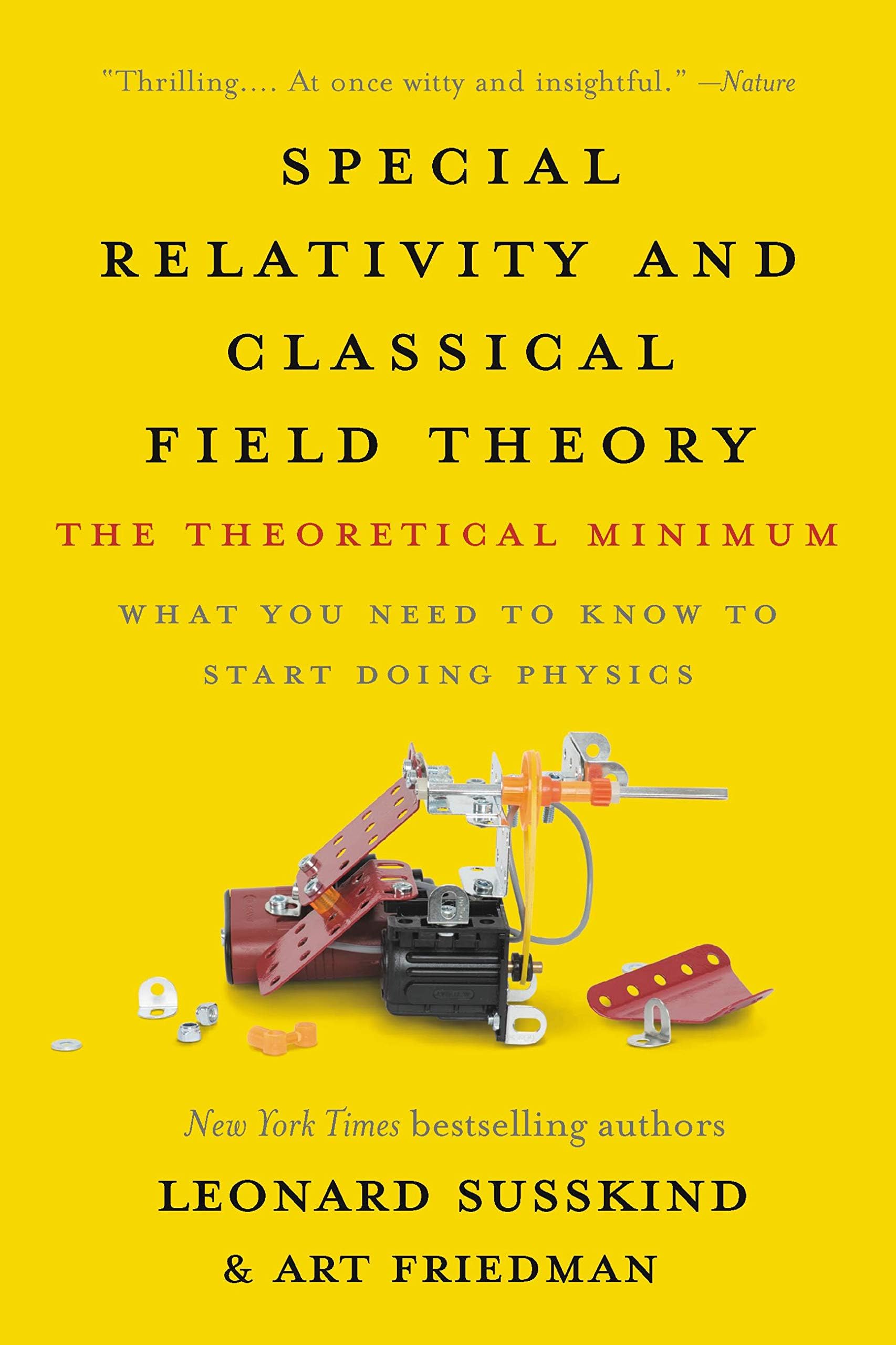
The third volume in the bestselling physics series cracks open Einstein's special relativity and field theory. “This is physics the way it's really done, in all its glory, nothing swept under the rug.”―Sean Carroll, author of The Biggest Ideas in the Universe Physicist Leonard Susskind and data engineer Art Friedman are back. This time, they introduce readers to Einstein's special relativity and Maxwell's classical field theory. Using their typical brand of real math, enlightening drawings, and humor, Susskind and Friedman walk us through the complexities of waves, forces, and particles by exploring special relativity and electromagnetism. It's a must-read for both devotees of the series and any armchair physicist who wants to improve their knowledge of physics' deepest truths. Review: if you would like to go deeper and understand the origin of spin - This latest book by Leonard Susskind and Art Friedman is a masterpiece. This well written book gets my five stars because, at least for me, it admirably lived up to its claim to present the theoretical minimum necessary to start doing physics. Let me further explain. (1) There are many well written books explaining the chemical properties of substances in terms of electron spin and the exclusion principle. But, if you would like to go deeper and understand the origin of spin, the non-physicist is in trouble because there are not many easily understood books written about relativistic QM. To this end I tried reading the relativistic QM chapter in Liboff's textbook. Although well written, I had trouble understanding the concepts because it assumed the reader had some prior understanding of special relativity, especially four-vectors and the Lorentz transformations. Here is where Professor Susskind's book saved the day. He covered this background material with enough clarity and in enough depth that I was able to re-read Liboff's chapter and understand it well enough to even successfully work some of the chapter problems. (2) As part of my physics self-education, I got a copy of Byron and Fuller's Mathematics of Classical and Quantum Physics with the goal of working through the first few chapters. At the end of the first chapter, there were some problems based on the Electromagnetic Field tensor. In hindsight, the problems were not difficult, but nevertheless, I had trouble because I lacked an understanding of the tensor and how its components interconnect and transform. Again, Professor Susskind's book was indispensable. His coverage of tensor manipulations, coupled with an excellent introduction to the field tensor gave me an understanding sufficient to solve the chapter problem. I found his treatment of Maxwell's Equations to be a breath of fresh air. For quite some time, I wanted to find an understandable interpretation of their meaning. I kept putting it off however, because in my reference E&M book, Maxwell's equations were first mentioned a discouraging 295 pages into the book. For the self learner, Professor Susskind's introduction makes so much more sense. He gives an interpretation of Maxwell's Equations first, and then shows how the Laws of E&M follow. That approach made all the difference for me. As a non-physicist, I found Chapter 7 particularly enlightening. All of the fundamental principles of modern physics were clearly laid out in this chapter. Although each principle had been discussed in previous chapters of this book and earlier books in the series, this chapter connected them all together into a coherent, understandable and insightful whole. Thank you Professor Susskind! The last chapter's discussion of the energy-momentum tensor is setting the stage for General Relativity. I cannot wait to get my copy. In general, the book was well written and logically constructed. It was real physics presented with humor and style. The "secret word" describing this book is "excellence". Review: Inspired - This is the three book in the series I have read. The first book set up a lot of the mathematical machinery used here, namely the Lagrangian and the Hamiltonian along with conservation laws and symmetries. I struggled a bit with the second book on quantum mechanics - have to go back and have another crack at that one. But this one was REALLY good. The setup of the book was so logical and the mathematical development was so well paced that I could feel much greater mathematical sophistication that helped me to anticipate many of the subsequent developments. Now, I will not say that I could erase all the equations and mathematical reasoning segments from the book, and as an exercise, recreate them from memory, calculation, and my own reasoning, but I will say that if you go over the material at a comfortable pace and are willing to look back a chapter or two or three to remind yourself of some key detail, you will be very well rewarded with a view into special relativity, electrodynamics, and classical field theory. Now back to Quantum. I cannot wait for General Relativity to come out. Chapter 11 seemed like almost like a cliffhanger to change gears into gravitational field theory. In your reference frame, take the time to read this book. As for general relativity, when it comes out, You Bet Your Life I will read that one.


| Best Sellers Rank | #63,718 in Books ( See Top 100 in Books ) #29 in Relativity Physics (Books) #80 in Cosmology (Books) #101 in Astrophysics & Space Science (Books) |
| Customer Reviews | 4.7 out of 5 stars 1,221 Reviews |
L**R
if you would like to go deeper and understand the origin of spin
This latest book by Leonard Susskind and Art Friedman is a masterpiece. This well written book gets my five stars because, at least for me, it admirably lived up to its claim to present the theoretical minimum necessary to start doing physics. Let me further explain. (1) There are many well written books explaining the chemical properties of substances in terms of electron spin and the exclusion principle. But, if you would like to go deeper and understand the origin of spin, the non-physicist is in trouble because there are not many easily understood books written about relativistic QM. To this end I tried reading the relativistic QM chapter in Liboff's textbook. Although well written, I had trouble understanding the concepts because it assumed the reader had some prior understanding of special relativity, especially four-vectors and the Lorentz transformations. Here is where Professor Susskind's book saved the day. He covered this background material with enough clarity and in enough depth that I was able to re-read Liboff's chapter and understand it well enough to even successfully work some of the chapter problems. (2) As part of my physics self-education, I got a copy of Byron and Fuller's Mathematics of Classical and Quantum Physics with the goal of working through the first few chapters. At the end of the first chapter, there were some problems based on the Electromagnetic Field tensor. In hindsight, the problems were not difficult, but nevertheless, I had trouble because I lacked an understanding of the tensor and how its components interconnect and transform. Again, Professor Susskind's book was indispensable. His coverage of tensor manipulations, coupled with an excellent introduction to the field tensor gave me an understanding sufficient to solve the chapter problem. I found his treatment of Maxwell's Equations to be a breath of fresh air. For quite some time, I wanted to find an understandable interpretation of their meaning. I kept putting it off however, because in my reference E&M book, Maxwell's equations were first mentioned a discouraging 295 pages into the book. For the self learner, Professor Susskind's introduction makes so much more sense. He gives an interpretation of Maxwell's Equations first, and then shows how the Laws of E&M follow. That approach made all the difference for me. As a non-physicist, I found Chapter 7 particularly enlightening. All of the fundamental principles of modern physics were clearly laid out in this chapter. Although each principle had been discussed in previous chapters of this book and earlier books in the series, this chapter connected them all together into a coherent, understandable and insightful whole. Thank you Professor Susskind! The last chapter's discussion of the energy-momentum tensor is setting the stage for General Relativity. I cannot wait to get my copy. In general, the book was well written and logically constructed. It was real physics presented with humor and style. The "secret word" describing this book is "excellence".
K**R
Inspired
This is the three book in the series I have read. The first book set up a lot of the mathematical machinery used here, namely the Lagrangian and the Hamiltonian along with conservation laws and symmetries. I struggled a bit with the second book on quantum mechanics - have to go back and have another crack at that one. But this one was REALLY good. The setup of the book was so logical and the mathematical development was so well paced that I could feel much greater mathematical sophistication that helped me to anticipate many of the subsequent developments. Now, I will not say that I could erase all the equations and mathematical reasoning segments from the book, and as an exercise, recreate them from memory, calculation, and my own reasoning, but I will say that if you go over the material at a comfortable pace and are willing to look back a chapter or two or three to remind yourself of some key detail, you will be very well rewarded with a view into special relativity, electrodynamics, and classical field theory. Now back to Quantum. I cannot wait for General Relativity to come out. Chapter 11 seemed like almost like a cliffhanger to change gears into gravitational field theory. In your reference frame, take the time to read this book. As for general relativity, when it comes out, You Bet Your Life I will read that one.
I**N
The Great Explainer
Groucho might have said: any decent mystery remains mysterious. I have 2 left hands & 5 thumbs. Practical I am not. I feel much more comfortable with theory and love the point that physics is much easier with mathematics. I haven't done any physics since first year university and have no desire to do any. Why do I keep reading it then? Fascination, addiction, to learning about the mysteries of life and the universe, that's why. And also I love to read about the mathematical tricks and techniques. I had read Dirac, Maxwell, books about Faraday and Maxwell (& Heaviside), but fields remain a mystery to me. So I bought this book, wondering if I could make any progress on that front. No offence to Art, but the professor emerges as The Great Explainer. Cataracts dropped away with phi(t, X). Especially when followed by a simple explanation that a variable x moving along its axis may be replaced by phi which can be seen as a field. Voila. That's all lovely. I adore the way mathematicians (& mathematical scientists) just replace stuff they don't like with stuff they like. And answers fall out. It's truly mysterious. Perhaps magic. But unfortunately the mystery remains. I get the above. Easy. Clear. But then we get to things like: every point in a space is associated with a field. Uh-oh. And things like particles moving in a field (electromagnetic, say) cause fields to move about the place and do things. Big uh-oh. My rat brain appears to be refusing to let go of a primitive aether-like notion for a field. A backdrop kind of thing. I fail to appreciate this other fog. It is beyond me. Yes, the iron filings above the bar magnet in junior high school were as clear to me as they were to the genius Faraday. But I hit a wall somewhere after that. O well, I guess I just have to accept that I'm not a natural physical scientist. I thought enough of the book to buy the Quantum Mechanics one too. I've probably read more on QM than any other area of science. But once again the Great Explainer made a few things clear to me. He (& Art) insisted that we have to know about The Action Principle and Lagrangians. So uh-oh, I would have to reprise high school physics again? So I reluctantly bought that one too. Have now read the three of them in reverse order. If I have energy (sum of T + V) I might review these other two eventually also. We'll see. I give the book 5 stars because I feel strongly that its shortcomings are my deficiencies, not those of the authors or the field. But like any decent mystery, the guts of it all remain mysterious.
F**W
Eagerly awaiting the next TTM book...
This is broad and clear presentation of the concepts required to understand the topics in the book's title. I've thoroughly enjoyed TTM video lectures several years ago. Nevertheless I've enjoyed reading the book and have learnt the subject even deeper by doing so. Including an important lecture that has been somehow omitted in the video lectures, certainly is a big plus. Eliminating distractions that come with live video presentation - such as repetitions, searching for a missing minus sign in a derivation, or a camera pointing to a wrong line on a blackboard - makes the material flowing very smoothly. Typos and imperfect Kindle formatting of math happen, but are easily detectable and do not distract from the contents. The explanations are perfectly tuned with an amateur physicist in mind. That wiseguy mentioned in the book also said, "I find television very educating. Every time somebody turns on the set, I go into the other room and read a book." This is the book to read!
M**L
Meets goal of "Theoretical Minimum", definite recommend (4.5 Stars if I could)
Writing this review from the boundary of a dog; specifically, there were dogs laying next to me or at my feet for most of my journey through this book. I thoroughly enjoyed this book! This book is very well written and provides plenty of motivation for the topics and calculations. I like the authors' sense of humor and clear writing style. I have had plenty of formal introduction to the topics of this text, so none of the information was new to me; however, I found that the authors' approach made everything seem as natural as can be. To me, there were very few moments (if any) of wondering "where did THAT come from?!" as can sometimes happen in traditional courses. Truth time: I just found out about this book series last month (December 2017) and learned about the first two books in the series (on classical physics and quantum mechanics, respectively) as I was placing the order for this one. Before I made it halfway through the book I went back and placed an order for the other books! I think this will be a great series to have on hand for quick reference to orient my thinking for the bridge between concepts and some calculations. There is a thorough introduction to the Lorentz transformations and the notion of 4-vectors, the vector potential, the electromagnetic field tensor, and transformation properties of these objects; there is also plenty of discussion on Lagrangian mechanics and deriving the equations of motion from the principle of least action. There is a decent development and explanation of the energy-momentum tensor at the end of the book. We bump up against the notion of gauge invariance, and there is some discussion of the consequences that this has for electromagnetism (i.e., the continuity equation follows from gauge invariance). In an aim to meet the "theoretical minimum", some topics are ostensibly left out: differential forms and their connection to Maxwell's equations, and while the title contains "classical field theory", there is no mention of vector fields or tensor fields at all. I would have liked to see some further explanation of vectors and their metric dual one forms; to be sure, they are used extensively throughout the text, but I think a novice to the subject could be confused as to why we even draw a distinction between them at all. (Perhaps in the future book on General Relativity this will happen?) The last lecture contains the most information of field theory, but I was left wanting a bit more. Certainly, the discussion of gauge theory is quite sparse; and understandably so there is no mention of Lie groups, principle bundles, or connections. What else? I would have liked to see more exercises throughout the book. It seemed like there was the span of many chapters without exercises to orient one's self. Towards the end of the book there is a higher density of exercises (as the material gets heavier), but even a few exercises per lecture would be beneficial. Hopefully in the coming books on General Relativity / Quantum Field Theory there will be more exercises (the weight of these subjects certainly demands it). All in all, I think this book is great and look forward to reading it again when the time comes, and to the other books in the series. Cheers on a great job!
E**Y
Great read for anyone with a passion for learning physics
I am a mathematician who studied some physics in my math university degree. However, it is with this book and the other two books in the same series (so far, in addition to this one, I have read and studied the ones of classical mechanics and quantum mechanics) that I have really learned the modern physics subject. I have enjoyed the excellent balance between mathematical aparatus and complex physical intuition/concepts. You can guess I am now looking forward tu studying the one on General Relativity. I can not help but to pay a visit to my already friend the energy-momentum tensor in its very homeland.
M**M
Whew.
You’ll wade through this if you have a below average math background. Use with calculus for dummies. You’ll be happy when you finish and set aside for a second read.
J**E
Bigger and Badder (in a good way)
Full disclosure: I'm writing this review because I want this series to sell more and be so profitable that the authors will crank them out faster. Maybe Oprah can revive her book club and feature them. I've read the other two books, and this one is definitely the most challenging and covers the most ground (btw the first book should be considered a prerequisite if you don't have a good understanding of Lagrangian/Hamiltonian mechanics). You definitely won't feel like stuff is dumbed down; when they need tensors, they will trot out tensors. Maxwell's equations will be introduced first and used to derive the simpler EM laws. You'll get a pretty deeper idea of how magnetism and electricity are connected by relativity, how the least action principle works with fields and not just particles, and maybe how the Higgs field gives some particles mass (though you may not realize it until later). You don't even have to live in a trash can or do all of the problems or even understand every page to get a lot out of the book, though I'll probably give it another read-through (or at least do some exercises) before the next one on GR. I'm curious to see what the theoretical minimum is for that!
P**.
Excellent for self-study
After retiring and reading several of Brian Greene's books, I decided I wanted a lot more math and physics background.In the last few years I have read or at least skimmed many basic and advanced volumes [including The Theoretical Minimum #1], which prepared me to appreciate the brilliance of the text and presentation of Special Relativity and Classical Field Theory. Perhaps it's the perspective added by Art Friedman that makes this so accessible to the interested but amateur reader.The development and consistent referencing of the lagrangian and action principles are very enlightening, and in a highly entertaining story to boot. A multiverse full of thank yous to Professor Susskind for the time and energy you have devoted to helping your fellow man to appreciate some of the wonders of the physical world.
A**R
Whatever it was, I understood it
I used to teach high school physics. Before reading this book, I would never have taken a course in Special Relativity and Classical Field Theory that had me as a teacher. I could do it now, because I've just read the clearest explanations of these topics that I've ever seen. This is the real deal, not a popularization. It even includes some tensor math; the first time I've understood it. A decent math background is needed, but if you have it, a lot of physics will make sense.
K**R
A good introduction to Special Relativity.
Great content and links to on-line lectures.
L**A
Una forma asequible a la vez que rigurosa de explicar conceptos físicos no triviales.
Tercer título de una magnífica serie de libros dirigidos a los que nos quedan cortas las obras de divulgación científica, pero no tenemos formación en física más allá del bachillerato. Imprescindible.
G**E
Very good, but...
I hesitated a lot before scoring this book 5*. In fact, the approach, through the least action principle, in special relativity is very original and worth to be read. Now, the book has a very mathematical approach on the one hand and after reading, I still feel the flavor of no rigorous process at stake for finding the Lagrangian of a given situation... There are also some basic questions on which I do not necessarily agree, as usual for books of physics, in particular concerning the equations of Maxwell and their interpretation. It is also a pity that no reference is made to the quantum experiment of Aharonov and Bohm showing the physical reality of the potential vector, and I would have liked seeing a discussion of its implications for gauge invariance...
Trustpilot
1 day ago
2 months ago