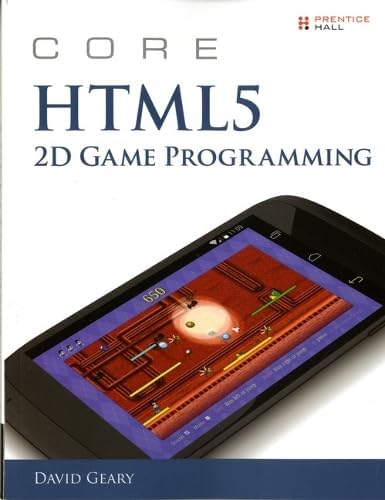

Core HTML5 2D Game Programming 1st Edition
Product ID: 12409036
Buy anything from 5,000+ international stores. One checkout price. No surprise fees. Join 2M+ shoppers on Desertcart.
Desertcart purchases this item on your behalf and handles shipping, customs, and support to Kyrgyzstan.
Full description not available
R**C
An Introduction To Game Programming With A Side Of HTML5
Other have already covered that this book isn't for beginners, but please do not think that you need to be an expert in technologies such as Javascript, HTML5. CSS3, or object oriented programming to learn from this book. It is clear from working through this text that the author going out of his way to explain the material in such a way that someone who is interested in the material itself could reasonably follow along.As an educator, I picked up this book hoping to use what I could learn from it to develop HTML5 tools and games to help make my work life easier. i also had vague hopes of creating web games for teaching sixth graders arithmetic skills. My previous experiences with the aforementioned technologies were very limited in scope, and I would most definitely classify myself as an amateur, if not a hobbyist.Yes, you will need to work through this book. It very much follows the form of a workbook designed to pass on a single skill. More so than the technologies it is composed it, it does an exceptional job of teaching you what actually goes into a game. I had zero difficulty, after working through the text (it took me roughly 20 days), moving onto my own projects of similar scale and scope. How many texts have you worked through that explained only how to complete the pet project of the author?This book is most definitely not like that. In some sections, such as chapter 6 on handling sprites, it goes into more than enough detail than the in-book project really needs. Several side cases are explained for related scenarios that will be immediately helpful to anyone looking to move beyond this text and into their own projects. Again, and I can't emphasize this enough, buy this book for the top-notch writing and the in-depth explanation of the systems at work.I will say that this book is very much a from the ground up work. You won't be working with a any particular graphics library or tool chain. You will be handling everything in a non-abstracted bare-bones manner. This is excellent for educating the reader on what is actually going on when you want to, say, key a sound to an event. However, this detail does make some sections more difficult to follow for the novice reader. That isn't a criticism as the author is very clear that they are not the target audience, but I took a risk and am glad I did.I would recommend this book to two classes of individuals. For those looking for an introduction to general game programming in a technology agnostic setting, this book outshines much of the competition. The writing is clear, concise, informative, humorous, and never condescending, even when explaining difficult bits of information.I would also recommend this book for anyone looking at moving beyond a basic understanding of HTML5 programming in general. The chapter on user interface alone was directly applicable to the work I was already doing on an application for managing my classrooms. Don't let the subheading "2D Game Programming" fool you, there isn't anything in the book that isn't directly applicable outside of that scope.If you need any further help making the decision on if this book is right for you, consider that it has a three chapter explanation of time, wherein it breaks down everything from linear/non-linear motion to developing a tick based time system for manipulating time in a game setting. That sounds pretty extreme, but I never once felt like the author was talking over my head or excessively using jargon to abstract away a discomfort with the material.It is clear the author loves what he does and takes pride in his work. As an educator, I couldn't ask for more in a technology book than this book delivered.
M**N
almost worthless
The link for source code, as specified in the book and above in the book description is dead ( takes you to some site that asks to install an extension - would it really be that hard to redirect to a github repo?!?! ). Sans source code the book is pretty much worthless.I'd strongly advise against purchasing it.
L**I
A great introduction to game development from an HTML5 perspective
Full disclosure: I received a copy of this book free of charge from the publisher to write this review. I received no other compensation for writing this review, and I have tried to stay as neutral as possible.The book guides you through the process of writing an HTML5 game from start to finish. It uses no external libraries, walking you through everything from input to animations to collision detection to physics. In reality, most developers won't do this -- libraries exist to make your life easier, reinventing the wheel, etc. However, knowing these concepts is essential to becoming a game developer, so it is worth reading regardless.Reading this book requires basic knowledge of HTML and CSS, as well as mild knowledge of JavaScript. You can replace the JavaScript requirement with most OO languages. If you know your way around multiple languages already, chances are you can easily follow along with the JavaScript examples. Just know that the intention of the book isn't to teach you any of these. If you want to learn JavaScript, look elsewhere.The book's target audience is definitely more on the beginner side. If you've worked on game development before, and are just looking to move to HTML5, you may get more out of Geary's other book, Core HTML5 Canvas. This book spends a fair bit of time teaching the reader about game development fundamentals that anyone experienced will already know.My overall impression of the book is widely positive. Chapters are very dense and full of information. The game liberally uses screenshots, notes, and example code to demonstrate its points, but it generally does so without overbearing the reader with code (the requestAnimationFrame polyfill would be one of the very few examples of overbearing the reader with code -- teaching the reader about polyfills is good, tossing two pages of irrelevant/non-essential code in front of them not so much!). The flow of the book is spot on and is exactly how a beginner would write a game. Draw a static background/character, then slowly progress to interacting with it.The book uses proper game design patterns such as strategy and flyweight patterns to implement everything including jumping, movement, gravity, particle systems, etc. The author teaches you a very clean approach to developing games, which ensures proper performance and a manageable code base. The author's experience in the field definitely shows in this book.My complaints with this book are minor (hence the 5 stars), but I want to mention them in hopes the author will consider them. Don't take my complaints to be indicative of the quality of the book -- these are just things that stood out to me as needed fixing.First, I must critique the game itself. I feel this is probably the worst part of the book, albeit for trivial reasons. The game is just not fun. Animations are too simple and jagged, sprites look bland, gameplay is boring, controls are awkward (please use the standard wasd), first time playing through I had a pop up message warn me that FPS was low which killed me, etc. The very first thing I did after opening the book was try out the game, and I have to say it left a bad impression upon me. But, the quality of the game doesn't really detract from the material of the book. It teaches you how to make a game, leaving the game design up to you!My next impression from the first couple of pages is that the book uses too many, or just misplaced, notes. The author randomly mentions what a particle system is when it has no relevance to the content surrounding the note. They then tell you that you will learn more about them in chapter 16 -- 15 chapters away from what you are currently reading. Thankfully, this is not indicative of the rest of the book, which is much better with note/tip usage.Something else that stood out was the book makes it clear that you should not tie game events to the frame rate, and instead use delta time, which is a core concept in game development. However, in numerous places the author mentions that the game running at slow framerate can "wreak havor on collision detection algorithms". The author suggests implementing hacks to ensure low framerate doesn't occur (pg 109). I understand how complicated collision detection can get, and it is out of scope of the book, but the author never acknowledges the contradiction.My final real complaints lie in the mobile section. The book does a decent job of explaining how to get HTML5 games running on mobile devices, but it doesn't mention CocoonJS (or Intel XDK), which makes HTML5 game development a lot easier by providing a fixed platform as well as exposing hardware features and platform specific functions like in app purchases (which is impossible without CocoonJS). The way the game detects mobile devices is also somewhat flawed -- it just checks if the device has a touchscreen. My laptop has a touchscreen, and the game thinks it is a phone/tablet. I feel like a book that has a picture of a mobile platform on the cover (and no other platform!) should spend a bit more time focusing on that platform.Overall, I would recommend this book to anyone that is looking to get into game development and wants to go the HTML5 route. It is both a great introduction and a great reference for anyone beginning game development.
6**R
Fell far short of expectations
Expected the book to teach me step by step how to build/write a mobile game from scratch. But instead it lists and explains pieces of the game code that has already been written, and in later chapters says that the code needs to be modified because the way it was implemented would not work for certain situations. So, I had to keep going back and forth to see the difference. Why not just code it right the first time? The topics discussed were great, but this book is not for beginners. If you don't know OO Javascript, then you might find the code hard to follow. My biggest disappointment was that I was expecting the book to teach me how to make a game into a web application, possibly by use of ADT for the Eclipse IDE, since the cover of the book shows the game on a smart phone. But it fell far short of that. On top of that, the game is not playable - once I start moving the main character, it does not stop even though I let go of the key! And there's no way to contact the author!
Trustpilot
2 weeks ago
3 weeks ago