๐ถ Elevate Your Audio Experience!
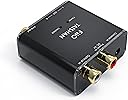
The D3 (D03K) Digital to Analog Audio Converter is a high-performance device that converts coaxial or optical digital audio signals into analog stereo output. It supports a wide range of sample rates up to 192kHz/24bit, ensuring exceptional sound quality. The device features a Cirrus CS8416 digital receiver chip and comes with a 6ft Micca optical Toslink cable, making it a complete solution for audiophiles seeking to enhance their listening experience.
| ASIN | B005K2TXMO |
| Brand | Fiio |
| Brand Name | Fiio |
| Customer Reviews | 4.6 out of 5 stars 2,842 Reviews |
| Global Trade Identification Number | 00741360330993 |
| Interface | Coaxial |
| Interface Type | Coaxial |
| Item Dimensions L x W | 2.43"L x 1.93"W |
| Item Weight | 4 ounces |
| Manufacturer | FiiO |
| Maximum Supply Voltage | 5 volts |
| Model | barb60FG |
| Mounting Type | Cable Mount |
| Number of Channels | 2 |
| Number of Pins | 6 |
| Part Number | barb60FG |
| UPC | 741360330993 887467454849 |
N**S
Very Good -- for the money
I'm giving this five stars because it does what it is supposed to do for a nominal sum of dollars. I suspect most people buy this for the reason I did--I have an Apple TV module and I wanted to be able to use the optical audio output connected to a stereo receiver. However, both digital audio inputs are in use on my AV receiver, so I needed to be able to convert the optical audio from the Apple TV to analog before it was send to the receiver. It comes with both a power supply and a very cheap, thin, optical audio cable. I would advise using a better one. Even optical cables purchased from big box retail stores will be better than the one included with this DAC. I didn't know that toslink cables could be this thin. Setup was perfect and easy. However, please note that this DAC will not supply audiophile sound...it's not even close. But for the price, what do you expect? I have Cambridge Audio DACMagic Plus and original DACMagic DACs connected to some fairly good analogue stereo equipment. For fun I connected the FiiO to the same equipment so that I could compare. Like I said--not even close. But, I still give the FiiO five stars because for $25 I can connect my Apple TV to my nonaudiophile AV system and get decent sound. It's a decent product at a decent price. FYI--the power supply for this unit is 5 volts at 0.3mAmps. If it stops working, regular USB power will work--so a power supply for an iPod or iPhone will work. It's nice to have that kind of backup. Finally, if the Apple TV's optical digital output is equivalent to that of the Airport Express, then the Apple TV is capable of seriously good audio output. If that's what you are interested in, purchase a quality budget DAC, such as the Musical Fidelity V-DAC II or Cambridge Audio DACMagic 100, for about $350. Then, buy a GLASS (quartz) toslink cable. Your sound quality will be as good as the digital quality sent to the Apple TV. If you are streaming either the original AIFF/WAV bits from a CD rip or else Apple Lossless (ALAC), the sound quality will be VERY good.
L**S
Airport Express, FiiO, and high-end Audio System - Impressions
I have used Airport Express audio as an input to my audio system occasionally for several years, but I never gave it a serious evaluation for quality, other than noting it seemed "very good". For serious listening, we always tossed in a CD. Arrival of an iPad (with Airplay) in the living room, where the audio system resides, caused me to take a closer look at the potential for good audio with digital input from the Airport Express. I have a large iTunes collection, but never played much of it through Airport into the big audio system. My questions were: How good is Airport Express audio output when mated to my own above-average audio system (~$3000 speakers, $1000 two-channel stereo amp, high-quality cables, excellent CD player, large listening room)? Does using a DAC such as this FiiO improve the audio output from Airport to the above system? The answer I arrived at in my testing is that the Airport Express (using the older rectangular N model for this test) delivers excellent audio output from its integrated DAC, and using the FiiO D3 as an optical DAC between the Airport and audio amplifier does not noticeably improve or worsen the results. Every system will be different; there are huge variables in equipment interfaces, listener taste, and perception of final audio output. My system is very accurate and "neutral". My main test was playing a classic audiophile evaluation CD (Herbie Hancock, "River - The Joni Letters" - a great album, BTW) directly from a high-end CD player into the amplifier, and playing the same audio from a 320kbps mp3 rip of the CD through iTunes to the Airport Express, then either directly from the Airport to the amplifier, or through the FiiO to the amplifier. With this setup, I did blind A/B testing, shifting the amp input back and forth from the CD input to the Airport input. Neither I nor others could tell the difference, or call one source better than the other in audio characteristics. Both sounded great. The audio direct from the Airport seemed to have minutely less definition than the optical out from Airport to FiiO to amp -- but it was so small as to be a questionable perception. No one could reliably distinguish the CD to amp versus the Airport to amp, switching back and forth while playing the same album. I also ran several other CDs, including opera, vocals, classical, and rock. Results were much the same. Ears vary in accuracy; mine are better than average; I am sensitive to distortion and definition - but I make no claim to "audiophile golden ears". Different equipment combinations will offer different results. A "cheaper" or less accurate system may actual display more difference in the perceived quality between the Airport audio direct, and Airport via FiiO DAC audio. My end result: I left the FiiO in the system, running the optical from Airport to FiiO, and audio output from the FiiO to the amp. If the FiiO dies, I will toss it and just plug the audio cable into the Airport - and be satisfied. Of course, most of the mp3 files in my iTunes collection are of lower quality than the "highest quality" mp3 files I used in this test. However, it is clear that on my system and with my ears, a very good mp3 rip (320kbps, Apple lossless, or a FLAC rip) played via iTunes and Airport Express is NOT distinguishable to me from the CD player input. BTW, I also test the same CD, in a FLAC rip, via VLC, running through Airfoil to the Airport Express. Same excellent results. Conclusion: If you using Airport Express to drive a good audio amp, using the FiiO D3 as a DAC between the Airport and amp is unlikely to improve or worsen the final audio output. For less than 30 bucks, you too can spend an evening figuring this out.... Addendum, May 2017. After several years of frequent use, this is still working great. This gets an A+ from me, and I changed the rating to five stars.
E**L
A unique solution for a unique problem
My mother is 80 years old and just got some amazing new Beltone hearing aids. They came with a device that is supposed to be hooked up to the audio output of a TV then will transmit the audio signal wirelessly directly to her hearing aids. In that way, she can watch TV and hear it in perfect stereo fidelity while the person next to her reads a book and can't hear the TV at all. The problem is that her Vizio TV had only one audio output - a digital optical output. The Beltone device used analog RCA plugs to receive the audio signal. She has a Yamaha receiver which has an optical input intended for TV audio so I thought that I would just connect the TV to the receiver then send the audio to the Beltone device from one of the audio out RCA ports. Worked great for radio and CD signals but the TV signal was totally absent. Then I found a note in the receiver manual that stated that the digital inputs were not sent to analog outputs. An Internet search uncovered the FiiO optical to analog converter. Exactly what I needed - in theory. I hooked the optical cable to the TV audio out and the FiiO optical input. The FiiO RCA plug analog outputs were connected to one of the receiver's audio input RCA ports then it was tested. It worked great! Not only could she hear the TV in great fidelity but she could hear the radio, CD player, DVD player (hooked directly to the TV) and Apple TV (hooked directly to the TV). The FiiO converter is certainly a niche product but for me it was the exact solution that I needed and the price was more than reasonable especially since it came with an optical cable.
A**J
Does The Job Well
Doing research, it turns out that optical audio does not deliver audio quality at current state-of-the-art levels, so don't expect audiophile quality. But it's fine for most purposes. I can hear the difference between audio coming via HDMI from my cable plugged into my OPPO 103 (a high-end audio/video processor/BluRay player) and then running analog out to my 2-channel amp, and what comes from my optical out from my TV into the same amp (My amp is a Pathos Classic Remix, a lovely sounding Italian tube/solid-state hybrid amp). There's a depth and sophisticated harmonic complexity I get when running from the OPPO to my amp (to my JM Reynaud Cantabile Jubilee floorstanding speakers), whereas running optical from the TV to the amp lacks the same level of harmonic complexity. But this is really most apparent when I'm listening to something that has music in it. On the other hand, the OPPO is only processing either the cable TV signal or BluRay/DVDs (or anything streamed through the OPPO, which has its own wireless streaming capability). But if I want to watch something sourced from the Roku or my TV's wireless streaming, my previous option before getting this optical/analog converter was to listen through the TV's speakers. But with dialogue, running via the OPPO results in a slight delay. Seeing someone talk on the screen when watching anything from cable TV results in the person speaking and the audio of that speaking not exactly time-aligned, and that can be a bit annoying. It's not off by more than, say, 1/4 second, but it's enough to be bothersome. On the other hand, using the optical out from the TV with this converter results in no delay. For most things, I don't miss the relative lack of harmonic resolution, and you probably won't either. If I am watching a high resolution music video, however, such as a concert or a concert DVD/BluRay, I'll use the audio through the OPPO if I can, but otherwise, this is just fine. I bought a pair of Amazon Basic RCA cables to run from this optical/analog converter. The converter includes the cable that goes from the TV's optical out to the unit. It's not a robust optical cable that comes with this, but unless you're going to be handling it a lot (which you might if you're running this out of a laptop, but you won't if it's from your TV), then that's not an issue. The only thing that does not come with this, other than the RCA cables if you're going to run this to an amp, is a USB power plug to go into a wall socket. Unless you're using your laptop's power, you'll need to run this into a wall socket. Not sure why this wasn't included, but make sure you buy one if you're planning to use it with your TV into either external speakers or an amp.
J**L
Works great, but caveat emptor about digital to analog conversion
I purchased this more expensive one instead of a $10 thing that does the same thing that was suspect for quality. It's definitely quality and works just fine. I set my RCA TV (LED HDTV 1080p 32" w/ DVD) to PCM audio mode and hooked up the digital coaxial audio output cable from the TV to this device, then I connected two red/white analog audio cords to my speaker system and the output was fine. The power cord for this device was a bit short, but worked for me. So just beware the power cord is just 3 feet, but the good news is that it's a standard kind of power cord (like those used for video cameras, more expensive cameras, external drives, etc), so you could order/buy a longer cord just about anywhere (not a regular cell phone cord, but the power cord that looks similar to them). My biggest issue was not with this product, but I'm mentioning it here as a compatibility warning. My TV did not allow for volume adjustment when I use this digital to audio interface. That is, when I used the TV remote to change the volume, it had no affect on the sound output. I had to control the sound from my computer input (HDMI) or from the analog output (my amplifier and speakers). The reason why I'm keeping this device, rather than going back to the 3.5mm stereo analog output to my amp that I was using is that the 3.5mm stereo analog output to my amp had a significant audible buzz in the absence of any input sound (like at the beginning of Back to the Future). This device helped to eliminate that buzz, but at the cost of having remote control. Perhaps the solution is getting a remote control device for my computer. Otherwise, the device does the job intended. Not sure $32 should worth such a small little converter. Maybe the price is really for the Micca optical cord interface which I'm not using. But I'm glad I spent the money, and as a composer who is moving slowly into more electronic music, I may find a use for it. I collect adapters and cords like this, because they always seem to come in handy.
M**T
This is what you are looking for!
I wanted a wireless headset to watch our LG Smart TV in silence so my spouse can study, or our daughter can watch after we go to bedโฆ This TV ONLY has one optical digital audio out, and none of the Bluetooth transmitters seem to take anything except the 3.5. I went to BestBuy and was told I was SOL. There is no kind of converter or anything I can get. I didnโt believe them, so I searched and after a lot of reading reviews, bought the following and at this time (2 days in) have the corresponding comments. I am reviewing all three together because they are a GREAT COMBO purchase!! FiiO D3 (D03K) Digital to Analog Audio Converter With Micca 6ft Optical Toslink Cable - 192kHz/24bit Optical and Coaxial DAC: nice compace size. Cable included so a GREAT deal! Works with no issues. Used a USB port on back of the TV for power, unit is kept out of way. Avantree Priva Wireless Bluetooth Audio Transmitter for TV with aptX Low Latency Codec, Connects Two Headphones, White: much smaller than I expected, and the magnet holds it to the back of the TV out of sight! USB power plugged in to power, no worries of battery dying. Transmission works fine, used the included 3.5 to 3.5 audio cable to connect to the converter above. RevJams Xec On Ear HD Wireless Bluetooth Stereo Headphones with In-line Microphone, Black: These are great! Feel comfortable, fold up to fit in the included pouch, charge pretty fast, and sound fantastic! I got perfect Bluetooth stereo sound, and the delay is relatively unnoticeable. I am very sensitive to this so I am very pleased with the result. The sound is so close and real, like a voice in the room behind me. VERY happy with these so far!
H**K
Easy to setup. Pretty much plug and play.
Included is the FiiO D3 Unit, a power brick for it, and a very thin feeling optical TOSLink cable from Micca (that worked fine, just doesn't encourage confidence). You'll need to get your own 3.5mm or RCA connector for the analog part of the connection. Plugged everything in and attached it to an older, 10+ year old JBL stereo system (which didn't have an optical in/out, attached via RCA cables) and a 1 year old Panasonic Viera TV (which did have an optical out, no analog out). No issues, pretty much plug and play and the sound quality is a large leap in quality compared to the TV. Power delivered by the FiiO D3 into the line-in on the JBL was also sufficient, didn't have to crank up the old stereo to an insane volume level to get sufficiently loud sound out. Also had a nice LED (that's not crazy bright, thank god) indicating connection status to the TV to verify that it was functioning and the optical line was engaged. There is a tiny bit of signal delay introduced with this unit (or its from my JBL stereo speakers, didn't test with more devices) that causes a noticeable echoing effect if both the TV volume are up and the speaker volume is up. Probably around a quarter second or so worth of delay. I didn't test different sound formats (DD, 5.1, 7.1, etc); only had it attached directly to the TV and the TV was set to stereo output. But more likely than not, if you're using this, you're only going to be using the audio out from this thing and not the original source. Extremely effective way of getting better sound out of a newer TV if you have some speakers lying around and don't feel like shelling out a lot of money for a new system/sound bar.
N**D
Connect your older sound system to a new TV
We bought an LED flat screen tv to finally replace our aging Sony boat anchor. But our "vintage" Technics Pre-amp was RCA only. The new tv's are optical out. So what's a skinflint to do? The spouse wanted to buy a compatible speaker bar to the tune of $200. Now, don't get me wrong, I LOVE my TV good-n-loud! But our 15 year old Boston speakers are still kickin' it. So we bought this unit as a bridge for east to meet west. Run the optical cable (included) from tv into converter (remove the shipping plug at the 'optical in' jack, as well as the the ones at each end of the cable). Next, connect the converter to the pre-amp that powers the speakers using an RCA to RCA cable (Left and right only (red and white)- no yellow video needed). THIS CABLE IS NOT INCLUDED but you may have one hanging around if you're buying this thing in the first place. The converter needs to be powered, and that cable IS included. Plug into the converter with the micro-USB end, and plug the other end into a USB jack, or use the INCLUDED wall plug w/USB jack and plug into that. Good to go. I read about concerns with sound lag when using any converter (That's when there's a delay between the visual and the audio, and they don't match up perfectly), but I don't detect any with this one. Price was a lot cheaper than yet another sound system in the house. Maybe I'll buy some headphones with the $$ I saved! This saavy shopper gave 5 stars for performance, ease of use, and inclusion of two of the three necessary cables. Well-packaged.
Trustpilot
2 months ago
2 weeks ago