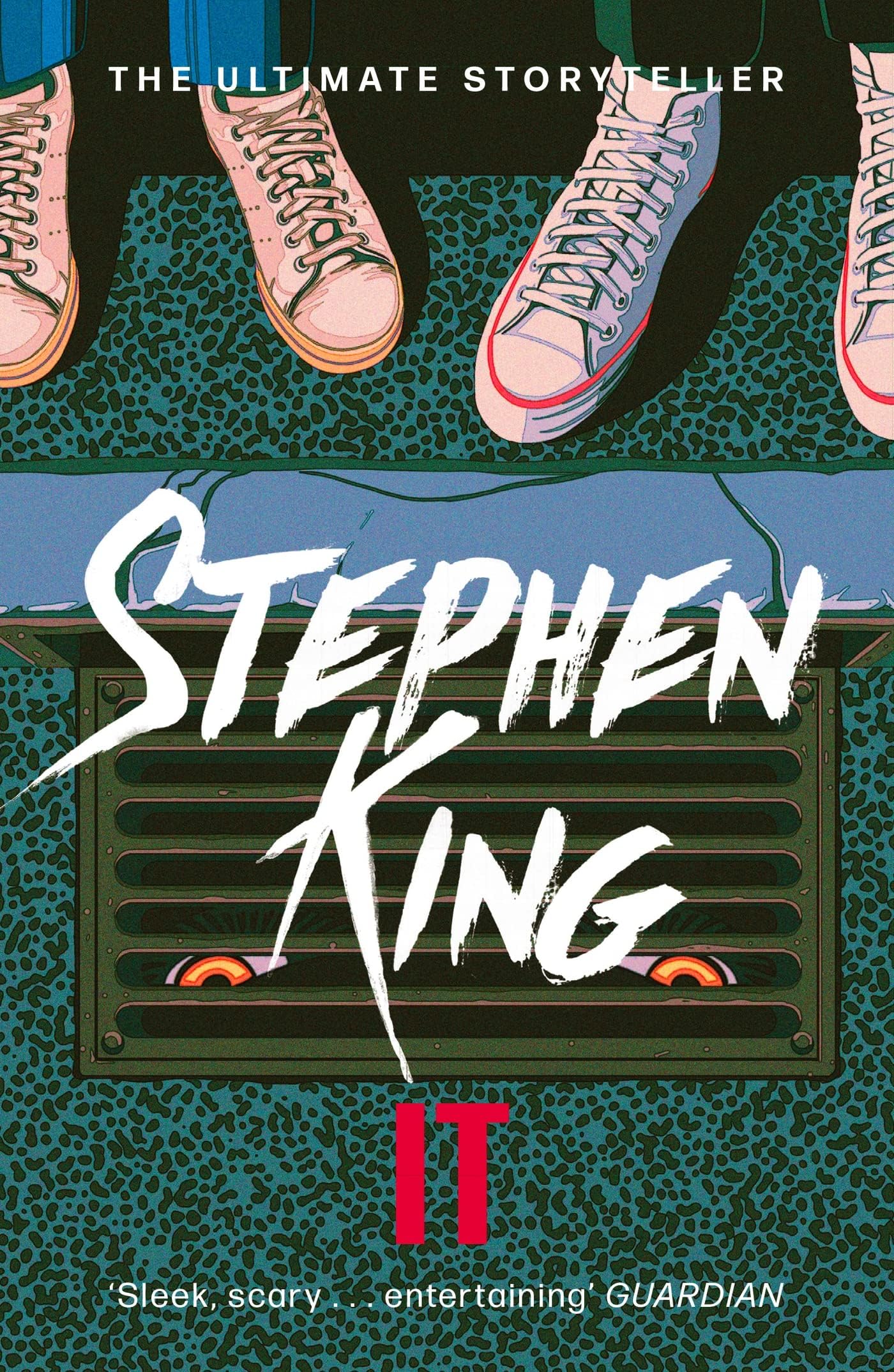
It
Product ID: 106059656
Buy anything from 5,000+ international stores. One checkout price. No surprise fees. Join 2M+ shoppers on Desertcart.
Desertcart purchases this item on your behalf and handles shipping, customs, and support to Kyrgyzstan.
Libro usado en buenas condiciones, por su antiguedad podria contener señales normales de uso Review: Hi-Yo Silver! Away!!! - Before this, I had only experienced Stephen King through the films. I read The Shining and wasn’t a huge fan, so I never really ventured further. Then I decided to tackle It — and let’s just say, It tackled me. I never expected to become so attached to a novel of this size and weight. Even after finishing, I keep going back to look up things I may have missed, re-reading certain scenes, just sitting in the story’s atmosphere. I can’t wait to see future interpretations beyond just The Losers. I feel like Welcome to Derry is only the beginning of what could be explored. This book captures childhood in a way that feels personal, even if your childhood looked nothing like theirs. The humor, the bravery, the innocence, the stupid fearless joy of being a kid with your friends — it’s all there. And even with something dark and evil looming, the story still somehow makes you feel young again. It makes you remember what it was like to have that one summer where the world felt both endless and secret. The bond between the Losers as kids and as adults is the heart of this story. You feel every laugh, every fear, every moment where they choose each other. And the history of Derry itself — the way the town has this weight, this memory, this darkness — was written with so much detail that it felt like a character of its own. The stories inside the story made Derry feel alive. King didn’t shy away from the ugliness either — the racism, the violence, the small-town cruelty — and I think it was necessary to understand what Mike Hanlon lived through and who he became. Mike ended up being my favorite character in the book. His perspective, his quiet strength, his insight — I walked away feeling like this was his story in a lot of ways. This was one of those rare books where I wanted to finish it — but I didn’t want it to end. The story stayed with me. The feelings stayed with me. It made me think about childhood, memory, loss, and the parts of ourselves we leave behind. I didn’t just read about Derry — I felt like I lived there for a while. And leaving it felt like saying goodbye to something I didn’t realize I needed. Review: A Love Story Disguised as a Horror Novel - I've read a number of Stephen King's books over the past 15 years, and had also read a number of his short stories prior to that period. King has always genuinely impressed me with his incredible eye for detail, his sense of place, and his ability to steadily pay out the rope line of a story's plot. Additionally, of course, he's the Jedi Master of creepiness. Although I was familiar with the premise of IT --- indeed, I watched the ABC miniseries back when it first aired in 1990 --- , I had never taken on this massive work as a reading challenge. With the recent release of the big-screen adaptation of King's story, I felt that it was time to shift this novel to the top of my bucket list. Now, having reached the conclusion of this tale, I stand entertained, inspired, and deeply moved. You see, to me, IT is not simply an epic horror tale; I feel that is also a powerful odyssey of friendship, belonging, coming of age...and love. From the late 1950s to the mid-1980s, the narrative chronicles the lives and times of a group of young pre-teens growing up in the small town of Derry, Maine. These young people are brought together by fate and circumstance to forge a fundamental bond, upon which is built not only all of their intense and complicated interpersonal relationships but, ultimately, their shared commitment to confront an unearthly monster that has, for generations, stalked and murdered Derry's residents --- especially children. As the members of the "Losers' Club" grow to know one another, become playmates, and evolve the fierce and pure loyalty and protectiveness towards each other that are so characteristic of young kids, their showdown with It looms closer and closer. Of course, the story’s titular antagonist is, ultimately, the most frightening of the Losers’ Club’s foes. However, what childhood would be complete without the unwanted attentions of schoolyard bullies? Led by Henry Bowers, a seething, dangerously angry son of a poor local farmer, a group of boys a couple of years older and bigger than our young heroes is an all-too-familiar presence in Derry, and it repeatedly attempts to corner the “Losers” when they’re alone, or at least outnumbered. Under the mostly unspoken leadership of “Stuttering” Bill Denbrough, the Losers’ Club’s lovable misfits navigate their way through a strange 1958 summer, a season of weird and frightening revelations, discovering more and more about Derry’s many hidden secrets even as they reveal more and more of themselves, their foibles, and their fears to one another. Bill is clearly the linchpin of the group, made all the more so by his anger, terror, and guilt over the awful death of his younger brother Georgie, another of It’s victims. With Bill often taking point, the Losers’ Club manages to (mostly) stay out of the clutches of Bowers and his group of thuggish louts. These “lost” children create their own tribe of sorts, a surrogate family that provides companionship, love and support when most of the adults around them are too wrapped up in themselves and their own private hells to be much help. Beverly Marsh, the sole girl in this society of seven, is sort of a tomboy, whose generally greater maturity and budding sexuality throw an understandable monkey wrench into the group’s dynamics. Stan Uris, one of the few Jews in Derry, is quiet, bookish, and sensible; Richie Tozier is the wise-cracking obnoxious kid with a heart of gold. Ben Hanscomb is the gentle and whip-smart fat kid who is brave beyond his years. Eddie Kaspbrak, smothered by his hyper-protective mother and suffering from crippling hypochondria, is imaginative and inventive and loyal to a fault. This septet is rounded out by Mike Hanlon, only child of one of the only African-American farmers in the area; Hanlon is, from the start, the group’s scribe, in fact carrying on in this role into the Losers’ adulthood...he is the only one of the seven who will stay in Derry through the seasons, years, and decades, until, in 1985, the horrifying disappearances and murders which seem to plague the town every 27 years or so begin again. Hanlon has watched and waited, like a sentry, wondering if he will ever have to contact his friends from so long ago, friends who have moved on to a wide range of professionally successful but sometimes personally haphazard lives. Moreover, he is unsure not only if the grownups sprung from those children of 1958 will adhere to the promise they all made to return to Derry to confront It if It should resurface, but if they will remember that era of their existence at all. As with the greater community of Derry, individuals there often seem to lose connections with their pasts, as if afflicted with some kind of metaphysical amnesia. By turns eerie and cheerful, terrifying and ridiculously funny, IT takes us on a tour of what it was --- and is --- to be a kid. You dream big dreams. You skin your knees. You find puppy love. You make friends. You suffer setbacks and even full-blown tragedies. If you are one of those folks to have had the good fortune of having a few really close partners-in-crime with whom to spend the lazy days of summer, then King’s novel will, I think, deeply resonate. The exquisite use of detail to accomplish painstakingly complex world-building, of which King is truly a master, breathes real life --- and death --- into Derry, Maine. The movement of the narrative back and forth in time is achieved quite seamlessly, and the author’s attention to what I’d call the continuity of experience helps readers to much better comprehend the twisted and disturbing history of the town, and to appreciate the raw passage of years, both during the lives of the main and supporting characters and in the time periods of some of the narrative flashbacks that provide the audience with a rich backstory. The intrepid heroes of this very long and sophisticated novel love each other. They stay loyal to each other, even when, sometimes, their hearts are breaking and they are losing faith in everything around them. They have, in the modern vernacular, each other’s backs. The innocence of much of their summer shenanigans is counterpointed powerfully by moments when each of them faces unpleasant truths about their families, as well as by the crucial points in the story at which the lurking, quintessential evil of It shows itself, however fleetingly. As Bill and the rest move inexorably toward their encounter with Derry’s awful monster, they are, in many ways, simultaneously leaving their true childhoods further and further behind, just as, in the intervening generation or so between their various departures from the town and their perhaps foreordained return to it, their memories of that time and place fade like a mostly-forgotten nightmare. I could not recommend this novel more strongly. As a thrilling and thoughtful example of the best that the horror genre has to offer, IT is superb. However, as I said before, I believe that, when you take the journey to this haunted New England town, and face down monsters both human and inhuman, right alongside some of the most genuinely childlike characters to have ever graced the pages of a literary work, you will remember what it’s like to dream, imagine, dare, and love, all over again.


| Best Sellers Rank | #682,060 in Books ( See Top 100 in Books ) #16 in Supernatural Thrillers (Books) #46 in Horror Literature & Fiction #1,334 in Contemporary Literature & Fiction |
| Customer Reviews | 4.6 out of 5 stars 53,278 Reviews |
K**N
Hi-Yo Silver! Away!!!
Before this, I had only experienced Stephen King through the films. I read The Shining and wasn’t a huge fan, so I never really ventured further. Then I decided to tackle It — and let’s just say, It tackled me. I never expected to become so attached to a novel of this size and weight. Even after finishing, I keep going back to look up things I may have missed, re-reading certain scenes, just sitting in the story’s atmosphere. I can’t wait to see future interpretations beyond just The Losers. I feel like Welcome to Derry is only the beginning of what could be explored. This book captures childhood in a way that feels personal, even if your childhood looked nothing like theirs. The humor, the bravery, the innocence, the stupid fearless joy of being a kid with your friends — it’s all there. And even with something dark and evil looming, the story still somehow makes you feel young again. It makes you remember what it was like to have that one summer where the world felt both endless and secret. The bond between the Losers as kids and as adults is the heart of this story. You feel every laugh, every fear, every moment where they choose each other. And the history of Derry itself — the way the town has this weight, this memory, this darkness — was written with so much detail that it felt like a character of its own. The stories inside the story made Derry feel alive. King didn’t shy away from the ugliness either — the racism, the violence, the small-town cruelty — and I think it was necessary to understand what Mike Hanlon lived through and who he became. Mike ended up being my favorite character in the book. His perspective, his quiet strength, his insight — I walked away feeling like this was his story in a lot of ways. This was one of those rare books where I wanted to finish it — but I didn’t want it to end. The story stayed with me. The feelings stayed with me. It made me think about childhood, memory, loss, and the parts of ourselves we leave behind. I didn’t just read about Derry — I felt like I lived there for a while. And leaving it felt like saying goodbye to something I didn’t realize I needed.
A**L
A Love Story Disguised as a Horror Novel
I've read a number of Stephen King's books over the past 15 years, and had also read a number of his short stories prior to that period. King has always genuinely impressed me with his incredible eye for detail, his sense of place, and his ability to steadily pay out the rope line of a story's plot. Additionally, of course, he's the Jedi Master of creepiness. Although I was familiar with the premise of IT --- indeed, I watched the ABC miniseries back when it first aired in 1990 --- , I had never taken on this massive work as a reading challenge. With the recent release of the big-screen adaptation of King's story, I felt that it was time to shift this novel to the top of my bucket list. Now, having reached the conclusion of this tale, I stand entertained, inspired, and deeply moved. You see, to me, IT is not simply an epic horror tale; I feel that is also a powerful odyssey of friendship, belonging, coming of age...and love. From the late 1950s to the mid-1980s, the narrative chronicles the lives and times of a group of young pre-teens growing up in the small town of Derry, Maine. These young people are brought together by fate and circumstance to forge a fundamental bond, upon which is built not only all of their intense and complicated interpersonal relationships but, ultimately, their shared commitment to confront an unearthly monster that has, for generations, stalked and murdered Derry's residents --- especially children. As the members of the "Losers' Club" grow to know one another, become playmates, and evolve the fierce and pure loyalty and protectiveness towards each other that are so characteristic of young kids, their showdown with It looms closer and closer. Of course, the story’s titular antagonist is, ultimately, the most frightening of the Losers’ Club’s foes. However, what childhood would be complete without the unwanted attentions of schoolyard bullies? Led by Henry Bowers, a seething, dangerously angry son of a poor local farmer, a group of boys a couple of years older and bigger than our young heroes is an all-too-familiar presence in Derry, and it repeatedly attempts to corner the “Losers” when they’re alone, or at least outnumbered. Under the mostly unspoken leadership of “Stuttering” Bill Denbrough, the Losers’ Club’s lovable misfits navigate their way through a strange 1958 summer, a season of weird and frightening revelations, discovering more and more about Derry’s many hidden secrets even as they reveal more and more of themselves, their foibles, and their fears to one another. Bill is clearly the linchpin of the group, made all the more so by his anger, terror, and guilt over the awful death of his younger brother Georgie, another of It’s victims. With Bill often taking point, the Losers’ Club manages to (mostly) stay out of the clutches of Bowers and his group of thuggish louts. These “lost” children create their own tribe of sorts, a surrogate family that provides companionship, love and support when most of the adults around them are too wrapped up in themselves and their own private hells to be much help. Beverly Marsh, the sole girl in this society of seven, is sort of a tomboy, whose generally greater maturity and budding sexuality throw an understandable monkey wrench into the group’s dynamics. Stan Uris, one of the few Jews in Derry, is quiet, bookish, and sensible; Richie Tozier is the wise-cracking obnoxious kid with a heart of gold. Ben Hanscomb is the gentle and whip-smart fat kid who is brave beyond his years. Eddie Kaspbrak, smothered by his hyper-protective mother and suffering from crippling hypochondria, is imaginative and inventive and loyal to a fault. This septet is rounded out by Mike Hanlon, only child of one of the only African-American farmers in the area; Hanlon is, from the start, the group’s scribe, in fact carrying on in this role into the Losers’ adulthood...he is the only one of the seven who will stay in Derry through the seasons, years, and decades, until, in 1985, the horrifying disappearances and murders which seem to plague the town every 27 years or so begin again. Hanlon has watched and waited, like a sentry, wondering if he will ever have to contact his friends from so long ago, friends who have moved on to a wide range of professionally successful but sometimes personally haphazard lives. Moreover, he is unsure not only if the grownups sprung from those children of 1958 will adhere to the promise they all made to return to Derry to confront It if It should resurface, but if they will remember that era of their existence at all. As with the greater community of Derry, individuals there often seem to lose connections with their pasts, as if afflicted with some kind of metaphysical amnesia. By turns eerie and cheerful, terrifying and ridiculously funny, IT takes us on a tour of what it was --- and is --- to be a kid. You dream big dreams. You skin your knees. You find puppy love. You make friends. You suffer setbacks and even full-blown tragedies. If you are one of those folks to have had the good fortune of having a few really close partners-in-crime with whom to spend the lazy days of summer, then King’s novel will, I think, deeply resonate. The exquisite use of detail to accomplish painstakingly complex world-building, of which King is truly a master, breathes real life --- and death --- into Derry, Maine. The movement of the narrative back and forth in time is achieved quite seamlessly, and the author’s attention to what I’d call the continuity of experience helps readers to much better comprehend the twisted and disturbing history of the town, and to appreciate the raw passage of years, both during the lives of the main and supporting characters and in the time periods of some of the narrative flashbacks that provide the audience with a rich backstory. The intrepid heroes of this very long and sophisticated novel love each other. They stay loyal to each other, even when, sometimes, their hearts are breaking and they are losing faith in everything around them. They have, in the modern vernacular, each other’s backs. The innocence of much of their summer shenanigans is counterpointed powerfully by moments when each of them faces unpleasant truths about their families, as well as by the crucial points in the story at which the lurking, quintessential evil of It shows itself, however fleetingly. As Bill and the rest move inexorably toward their encounter with Derry’s awful monster, they are, in many ways, simultaneously leaving their true childhoods further and further behind, just as, in the intervening generation or so between their various departures from the town and their perhaps foreordained return to it, their memories of that time and place fade like a mostly-forgotten nightmare. I could not recommend this novel more strongly. As a thrilling and thoughtful example of the best that the horror genre has to offer, IT is superb. However, as I said before, I believe that, when you take the journey to this haunted New England town, and face down monsters both human and inhuman, right alongside some of the most genuinely childlike characters to have ever graced the pages of a literary work, you will remember what it’s like to dream, imagine, dare, and love, all over again.
A**O
A rollicking good read... with a few quibbles
"It" is the third Stephen King novel I read (after The Shining and The Stand). Although very long, it makes for compulsive reading. I couldn't put it down during the year-end holidays. The story is very good. A small city in Maine is periodically purged by an unseen evil that is often associated with the presence of a grotesque clown. A group of child "Losers", outcasts for various reasons, manages to escape this redoutable presence and after a quarter century returns (with some attrition) to finish the job they started but neglected to finish. Members of the group are very well fleshed out and the interplay between their youthful and adult personae is diverting. The horror is also very well rendered and there is continuous suspense. I have just a few quibbles. The sex bit, to which I won't refer in order not to spoil the reading for others, is unnecessary and very creepy, not horror-book creepy but real-life creepy. It seems tacked on the rest of the book, does nothing for it and rather tarnishes it. Although the Turtle is hinted at early in the book the scenes featuring this character are unsatisfactory. More detail would have been nice. If there is only one It in the entire universe and it has always resided in what would later be known as Derry, Maine, it doesn't make any sense of the Chüd Ritual to come up in a Nepalese scroll (how would the Nepalese have known about It?). Also the scenes concerning this Ritual do not match what the Ritual supposedly was about (joke telling, laughing, etc.). Even though elements of horror story elements may be ridiculous in themselves the conventions of the genre require that they be taken entirely seriously for the story to hold together. This is not to say the book was unamusing. It is spellbinding, almost Proustian in its remembrance of the joys of childhood and full of popular 1950s culture details (music, TV programs, slang, movies) that give a certain weightiness not normally present in horror books. And, as a horror book it is very good. What better antagonist than one that may look and act like what each person fears the most? And what place is scarier than the tubes and ducts that are the modern equivalent of catacombs? If I were allowed to rate the Kindle version I read I'd give it 1 star. The software they used to copy the printed version into Kindle format still needs a lot of work. It misreads many letters and punctuation symbols, sometimes to hilarious effect. Of course it is fairly easy to read through these mistakes, but they slow the reading down and spoil it a bit. Horror stories should be read breathlessly so that one forgets the act of reading and is totally engrossed in the story. I recommend to whoever is responsible for these things to pay someone to proofread the books before they're sold over amazon.com. Kindle books (particularly those sold at commercial price) should be held to the same quality standards as printed books.
A**N
A modern classic that will linger in your mind
5 / 5 stars This is a tough review to write, because an 1100+ page doorstopper is a lot to take in and process. This book has become one of my all-time favorites (despite that scene), and I feel like I left a piece of my heart in the magically messed up town of Derry. I went into this almost completely blind - I hadn’t seen either the television series or the recent movies, but I knew the plot had something to do with a clown terrorizing children in the sewers and red balloons. I expected more horror, but instead I got a love letter to childhood, friendship, and summer, with undertones of loss, growing up, and growing apart. “The terror, which would not end for another twenty-eight years—if it ever did end—began, so far as I know or can tell, with a boat made from a sheet of newspaper floating down a gutter swollen with rain.” In true King fashion, the first 200 pages or so of this were slow. I found myself wondering what I got myself into, because one of my reading goals for 2020 was to read this book, but man, was it slow. Around page 500, I was completely hooked, and then by page 1000 I was ready for it to be done. Thankfully, for the most part, this was a thoroughly enjoyable ride, and I actually find myself missing the world of Derry. “It” has some of the best world building I’ve ever experienced. King’s tendency to over-describe and elaborate pulls through in this to make a town that seems so tangible, I had to remind myself that Derry isn’t actually a real place. From the barrens to the library, the sewers and the pharmacy, the standpipe and the park with the creepy Paul Bunyan statue, I had a detailed picture in my mind's eye. The wide cast of characters, including the town members like Mr. Keene, add to the realism of Derry. “But maybe I was wrong, he thought. Maybe this isn’t home, nor ever was—maybe home is where I have to go tonight. Home is the place where when you go there, you have to finally face the thing in the dark.” And the CHARACTERS. God, the characters. I love every member of the Losers Club, except for maybe Stanley. If I had to pick a favorite, I would say it’s a three way tie between Ben, Richie, and Bev. I loved watching them grow up and confront their past and fears while looking toward the future. I didn’t care for Stanley much, but that was because he was the most forgettable member of the club, and it felt like he was mainly there to bind the losers club together and serve as the realist.I thoroughly enjoyed both the past and the future, and still find myself thinking about the horrors the kids faced going against It in their younger days. I loved the Derry interlude chapters, and they really added a new layer of depth to the world. It was interesting learning the history of Derry through snippets of the past, and I thoroughly enjoyed the side stories of the Black Spot and the Bradley Gang. Something about no one acknowledging the terrors as they’re happening makes everything It does so much more spine tingling. It can be difficult to alternate between two perspectives, the past and the present, and from past experience when an author attempts it one point of view is written stronger than the other. That’s not the case here. In “It”, both the past and present were so poignant, and I wanted nothing more than happiness for both the kid and adult Losers. I think I liked the past chapters just a little bit more, because they had the unknown terror that kids face. It was also steeped with nostalgia and simpler times, and I found myself yearning for summers as a kid in my parents’ house. “The first note his father left him in that spring of 1958 was scribbled on the back of an envelope and held down with a saltshaker. The air was spring-warm, wonderfully sweet, and his mother had opened all the windows.” The ending is one of the most bittersweet endings I’ve read in a book, and it made me cry like a baby. It was a cathartic ending, and I felt sadness, relief, and wonder. It didn’t feel fair, but life isn’t fair, and no one knows that better than Mike and the other Losers. I’m so glad I read this book. It has cemented itself as one of my favorite stories of all time, and even though I finished it weeks ago, I still find myself thinking about it (and It).
J**Y
WONDERFUL, FRIGHTENING, and HARD TO PUT DOWN
I had read the book a long time ago. I decided to re-read after watching the TV series "IT-Welome to Derry." The book centers on 7 kids back in 1958 and again in 1985. As kids, they discover a powerful force that kills young children. It starts with the murder of George Denbrough, the younger brother of the Losers Club leader, Bill Denbrough. The members were Bill, Beverly Marsh, Ben Hanscom, Richie Tozier, Eddie Kaspbrak, Stann Uris, and Mike Hanlon. The Losers Club defeated IT in 1958. However, you do not really find out how until the last 25% of the book, when, as adults, they come back, to finally kill "IT." This was prompted by phone calls from Mike Hanlon, now an adult, but in the year is 1985, who was the only one that stayed in Derry after 1958. The book takes you back to things they did as kids at that time which range from getting a bunch of candy for a few pennies, going to the theater for horror movies, such as "The Crawling Eye" which I actually saw a kid. The club has to deal with being bullied by older kids, one that becomes dangerous when they return as adults. I think why I enjoyed it was many things they d8d as kids brought back memories of things I did except here you have the added horror of IT." The book is 1100 pages and takes time to read. When The Losers were kids were around 11 or 12. As adults, they face a fierce force and do prevail, but not before two of them die. I do not recommend this book be read by young kids because there are episodes of domestic violence where Beverly was the victim, vicious murder in Derry when the background of Derry is developed for the reader, and some sexual activity, though not graphic or detailed, involving Beverly and the 9ther club members. Stephen King was criticized for this, and it was never included in any movies or TV series. Regardless,it was a wonderful read, and I do recommend this book.
K**R
Even better the second time...a quarter of a century later.
When I was on a school field trip in the seventh grade, I took Stephen King's "IT" with me to read. The trip was going to be two days in Virginia, and was an example of staying overnight on a school trip. It should have been an adventure. The trip was frankly a waste, but the book was sublime. I'd gotten into reading Stephen King two years before by way of a trip over the previous summer to my uncle's house. He had a collection of Stephen King novels and I'd started reading them with Pet Sematary, which had been adapted to the big screen two years before. In the intervening time, I'd devoured Salem's Lot, Carrie, Firestarter, and Misery, and The Shining. I found a copy of the 1990 TV movie adaptation and watched it. I recognized just how much I figured it had to have been toned down, but it was a decent primer (or so I thought). I felt warmed up and ready for the brick-like tome I'd acquired. I was wrong. Reading the book was like a marathon, and I was prepared for a sprint. I easily identified with the younger versions of the characters, but had trouble with identifying with their adult incarnations. I appreciated the story and the implications of both eras, but entirely missed out on how well crafted the story was. In the end it took three weeks, but I completed the book, considered myself proud for conquering the nearly 1200 page tome, put it on the shelf, and...proceeded to put it out of my mind for nearly twenty five years. Almost, and entirely unintentionally, like the characters in the book... Twenty five years later, I was on a kick of re-reading books I'd read as a kid, and then I approached Stephen King again. In the interim I'd devoured his books and probably thousands of other books by many dozens of different writers of differing skill levels, and when I thought "I should re-read some Stephen King" I thought about it, and it came down to either reading "IT" or "The Stand" and to be honest I felt "IT" was the better book. I remember it being a mountain for an adolescent. I wondered how I'd do this time. It was SO MUCH better than I ever thought it would be! I felt ACHINGLY nostalgic in the sections with the characters as kids. Whereas as a kid I identified with those elements as mapping directly onto my friends and setting, I did it unconsciously. Now I was (at times painfully) aware of it. I longed for the good times and friends of my youth. I appreciated how well King encapsulated the distance between childhood and adulthood and all the roads we travel in between. I reveled in how little we remember accurately about the past and how mutable it can be. I realized that IT was in fact two predators...both the eponymous monster who will kill and devour you, and the predator that robs us of our memories and the clarity we remember having as a kid. The prose is wonderful. King doesn't use mere words to tell stories, he uses meanings themselves, woven seemingly seamlessly into shades of context and pigments of innuendo and occasionally bright, obvious splashes of unobfuscated emotion that jar you because...hey...in real life that's how it works. And in getting that right, King manages to make the impossible elements like the supernatural nature of IT and the relationship IT has with the town of Derry and the inhabitants there...normal. This could have happened. It could be happening. And it's that esoteric dread that King wields masterfully. The implications. The possibilities. Even in the fact that both eras are now, as of 2016, dated (the earlier phase was in the 50's, and the later phase was in the 80's...eerily we would be neck deep in the middle of the next cycle were it coming) was delightful. It was an added layer of nostalgia woven over the rest of the tapestry. If you haven't read this book, read it now. Enjoy it. If you have read it, by all means read it again. It will thrill and delight and horrify and frighten you all over again.
J**S
Great Book by Great Author
I’ve read this book 3 times now and enjoyed it each time. Don’t be deterred by it’s length as you will still be captivated throughout.
I**D
Great Coming-of-Age Horror Novel
I’d say I survived IT, but truly, I survived Derry. This tale wasn’t what I expected at all. It’s definitely a horror novel, but it’s also a coming-of-age story of a group of pre-teens trying to beat the heat of summer in their small town. This one thousand pager has it all. Lots of plot, lots of character development. King has excellent storytelling execution, as I really felt like I was transported right into every scene. I think having been exposed to the movie adaptations years ago, ruined some of the scary aspects. We all know about the creep clown, etc. There were some scenes that didn’t add to the story and I have lots of questions. Perhaps they were answered in the book and I overlooked them, but now I need to stalk all the Reddits and blog sites to get some answers! I recommend this book only to those who are truly interested in wanting to read THIS story. It’s so long and only worth it, if you’re up for that journey.
D**S
Brilliant
Classic. Hands down the best Author in the genre. Stephen King truly is King.
M**З
حلو
كتاب هدية
H**L
Un bon classique
Super produit! De bonne qualité à un prix plus qu'abordable. Les 2 volumes réuni en un seul livre. ATTENTION cependant cette édition est en anglais, exactement se que je chercher mais après avoir vue certains commentaires de personnes qui ne lise pas le descriptif il me paraissait important de le rappeler. En bref un très bon produit!
M**L
The real horror is not the clown but the way childhood fear follows you long after you grow up
Stephen King is not merely trying to frighten the reader. He is excavating the fragile architecture of childhood itself and asking what happens to it when time begins to erode the foundations. What makes King extraordinary here is his patience. He refuses the cheap mechanics of horror. Instead he constructs an entire emotional ecosystem where friendship, loneliness, cruelty, humor, and fear all coexist with unnerving authenticity. The terror works precisely because the human moments feel so disarmingly real. You recognize the laughter, the awkwardness, the strange intensity of childhood bonds before you ever confront the shadows that lurk behind them. King also demonstrates an almost anthropological understanding of memory. The novel treats childhood not as nostalgia but as a volatile state of perception. The world appears larger, stranger, and infinitely more mysterious through young eyes. King captures this with surgical accuracy. Streets feel endless. Summer days stretch like entire lifetimes. Small fears grow into mythic proportions. In his hands, memory becomes a landscape rather than a recollection. The true brilliance of the book lies in how effortlessly King blends the mundane with the uncanny. A quiet town, ordinary routines, and familiar places slowly begin to feel subtly off balance. Nothing is rushed. The dread accumulates gradually, like storm clouds assembling at the edge of the horizon. By the time the reader senses the scale of what King is doing, the atmosphere has already wrapped itself around the imagination. What elevates the novel beyond genre is King’s compassion for his characters. He writes them with such emotional sincerity that their struggles feel intimate rather than fictional. Their fears matter because they feel like people you could have known once, or perhaps still know somewhere in your own past. This is where King’s genius truly shows itself. He understands that the most enduring horror is never the monster itself. It is the unsettling realization that the world of childhood wonder and the world of adult reality are separated by a fragile and often painful transformation. And through that transformation, King proves something quietly remarkable. A horror novel can terrify you, move you, and leave you reflecting on the strange beauty of growing up long after the final page closes.
E**L
Been a fan of Stephen King since I was a little kid
This was a lovely story where a lot of growth is taking place from both main characters. The book is absolutely massive (1200 pages), but its bulk is used to accomplish all its greatness.
Trustpilot
1 month ago
1 week ago