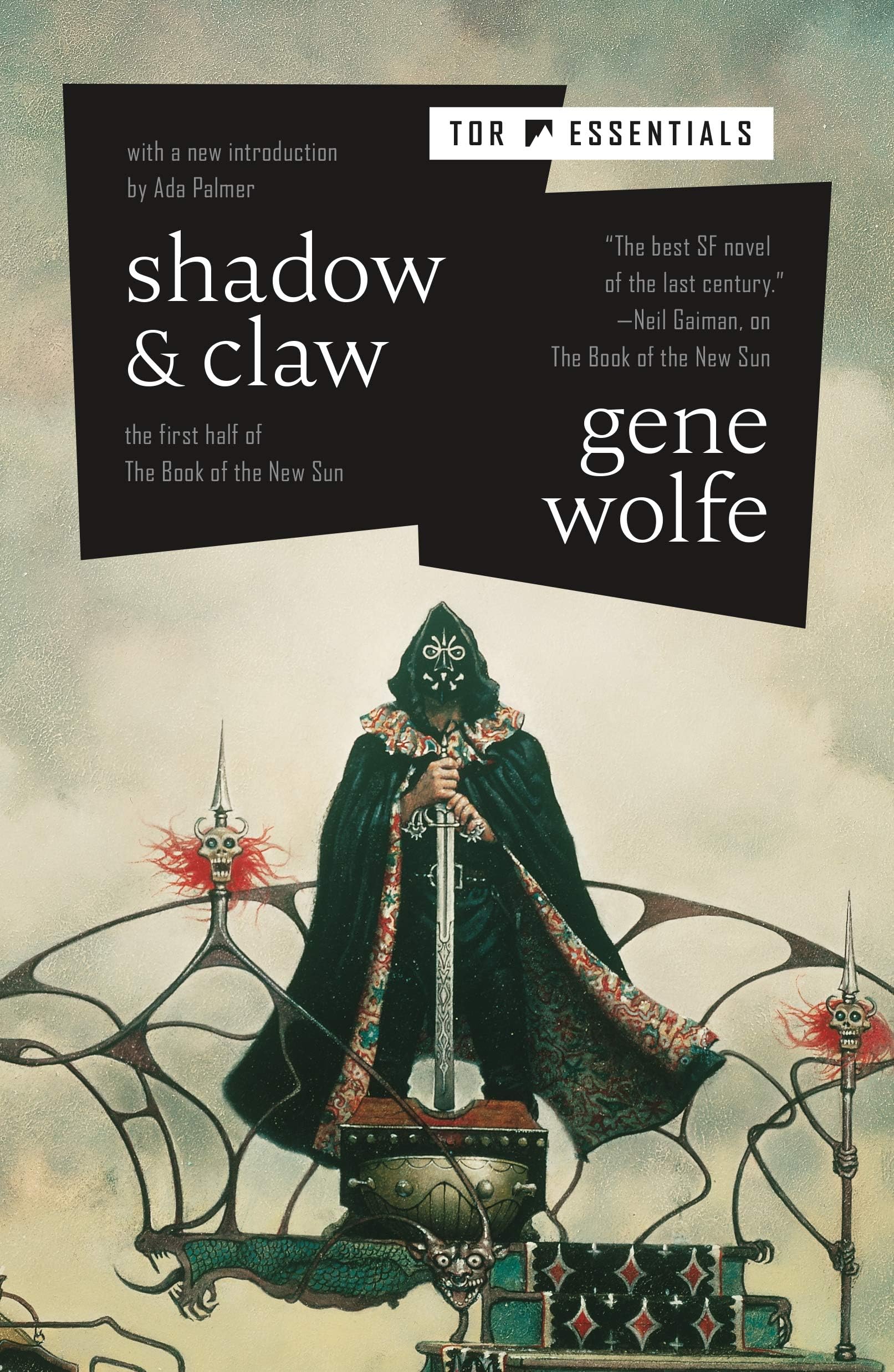
Shadow & Claw: The First Half of The Book of the New Sun
Product ID: 103706732
The Book of the New Sun is unanimously acclaimed as Gene Wolfe's most remarkable work, hailed as "a masterpiece of science fantasy comparable in importance to the major works of Tolkien and Lewis" by Publishers Weekly . Shadow & Claw brings together the first two books of the tetralogy in one volume: The Shadow of the Torturer is the tale of young Severian, an apprentice in the Guild of Torturers on the world called Urth, exiled for committing the ultimate sin of his profession -- showing mercy toward his victim. Ursula K. Le Guin said, "Magic stuff . . . a masterpiece . . . the best science fiction I've read in years!" The Claw of the Conciliator continues the saga of Severian, banished from his home, as he undertakes a mythic quest to discover the awesome power of an ancient relic, and learn the truth about his hidden destiny. "One of the most ambitious works of speculative fiction in the twentieth century." -- The Magazine of Fantasy and Science Fiction At the Publisher's request, this title is being sold without Digital Rights Management Software (DRM) applied. Review: Not run-of-the-mill - I started reading The Shadow of the Torturer with hesitation. Too much "genre" fantasy is full of boring and tired tropes, hollow characters, and predictable plots. To my delight, I found that Shadow was not going to fall into that category. The story opens up simple enough (alright, maybe this is one trope the book falls victim to) - a young man with no family leaves his home. In the very least, this is spiced up by the intriguing world it takes place in. Severian is a torturer, one of a secretive guild whose duty is to torture those deemed deserving. Throughout the four volumes composing The Book of the New Sun, Severian "practices his art" several times. The books are not gory or violent, however. Wolfe's prose turns the mundane into the fantastic and the terrible into the whimsical. Everything in this foreign world of Urth is described with thoughtful word choice that (most of the time) tells you more than you realize. Unfamiliar words create a believable yet strangely familiar setting throughout the story. Many complain that the vocabulary in the book is difficult or obscure - yes and no. It is not an easy book to read. If you have a strong vocabulary, you may recognize many words based on their roots (Wolfe often uses archaic words, but not made up words) and context. If you are the sort who doesn't mind looking up occasional words they don't recognize, you will certainly leave this book with a slightly larger vocabulary. But if you exclusively prefer novels written with a conversational tone and always familiar vocabulary, this book really may not be for you. Anyone and everyone should still give this book a try, but go in expecting to read slowly and thoughtfully. The story takes several twists and turns in strange and unexpected ways, but the plot devices tend towards thoughtful rather than absurd. I found myself thinking about how a given scene fits into the big picture rather than taking them on their own. In a lesser author's hands, The Book of the New Sun would certainly be a muddled and unfocused adventure with too many loose ends to be satisfying. Gene Wolfe, however, has proved himself to be a masterful writer (n.b. I am not a Gene Wolfe fanboy, The Book of the New Sun is the first and only thing by him that I have read). If you dig into these works, you will be rewarded with a depth of story found rarely in any genre. It is clear that the four books composing The Book of the New Sun were written at the same time, and this is a huge advantage over other multi-volume series. The writing is consistent and the storytelling is purposeful. I don't think Wolfe wasted much more than a word in composing these works. Also, the first book (The Shadow of the Torturer) on its own I found a little unsatisfying - perhaps rightfully so if you look at it as the first quarter of one large novel. During the second book (The Claw of the Conciliator), however, things really started to fall into place for me and I got deeply interested in the characters and happenings. So if you read Shadow and think to yourself, "Well, I could take it or leave it," do yourself a favor and read the second book, Claw of the Conciliator. I sincerely doubt you will find yourself less interested by the end of it. So, obviously I liked it. It was a thoughtful, interesting, and unique story. The writing is second to none and the text is rich with meaning if you care to look for it. It is a work that will challenge you from the beginning and reward you in spades. If you want a throwaway story to kill time, this isn't it. If you are needing more from a book, look no further. Review: Welcome to Urth. - THE SHADOW OF THE TORTURER Gene Wolfe's The Book of the New Sun is a popular recommendation in terms of non-traditional fantasy/science-fiction, and the man is well-respected by authors I respect so I figured it was time to find out why. The Shadow of the Torturer is the first book in a tetralogy and it feels like it. It's a little sliver of a world, a little taste-test of Urth (a planet with a dying sun) and its weary inhabitants, and then cuts off hard at the end, offering no real conclusion. In a sense I expected this, as this story is often sold as two volumes of two books, or even a single volume of all four books. So in a way I was ready for it to be a very... introductory type story, and it was. It is a very promising introduction though. I am a sucker for sci-fi settings that take place so far in the future that they end up feeling like the past instead. Science-fantasy, I've heard it called (though I prefer space-fantasy). The types of stories that rest on forgotten epochs and eons upon eons of history. Dune is like that. But unlike Dune Wolfe's books take place on Earth itself, or Urth. It is unclear just how far in the future the story takes place (at least, it's unclear at this time) but you can feel the history of the world. It's a tangible thing, and you can read it in the characters' faces, scry it in the ancient river Gyoll, see it in the massive border-wall of Nessus, and in the eerie halls of the Citadel... It's a world that feels old—with all of the strange mythos and cultural idiosyncrasies one would expect—and those are often the best kind. Now, I was less sold on the characters than I was on the world itself. The story is about Severian, an apprentice of the Order of the Seekers for Truth and Penitence, more commonly known as the Guild of Torturers. We are being told the story, in Severian's own words, of his exile from the guild and ascension to the throne of the autarchy. And while that story is really just getting started, the nature of Severian's unreliable narration is one of the more interesting parts of the series thus far. This unreliability could certainly be why I don't quite know how to feel about Severian yet, but the other characters that surround him sometimes felt like mere carriers of plot points instead of people with agency. I'm looking for improvement there. Beyond the story, beyond the characters, the writing itself is noteworthy. I must be on a path of difficult lexicons or something. First Wallace, now Wolfe. I should read McCarthy soon and complete the hat trick. Bring a dictionary, is what I'm saying. Better yet bring a google search bar, because not only is Wolfe using words of utmost antiquity, he's perverted them with time. Which is realistic, but does not help in the effort of deciphering the language. Vocabulary aside, the man can write. His prose is that of someone who loves language, and wants you to love language. And there were phrases that caught me in just the right way. So ultimately, it was a good start. And I did enjoy joining Severian as he encounters the wider world outside of his guild's Citadel. He has a lot to learn, and frankly so do I. THE CLAW OF THE CONCILIATOR A step up from the first book, I am considering giving this one all five stars. I felt that it lost some of its steam toward the end, but may yet still change my mind. In any case, certainly a step up. Though honestly it may just be the simple fact of getting more familiar with the world, more familiar with the characters. It's what generally happens in any series that I spend more time with (assuming consistent—or in this case improved—quality). The Claw of the Conciliator seems to take a firmer grip on what Wolfe is shooting for this series to be. Drug experiences, strange creatures, non-linear time, secrets and myths, even tongue-in-cheek stage plays, all of these things lent to a more... involved feeling story for me here in book two. Severian... I still don't know what to think about Severian. He has a strong sense of justice, and often does honorable things. He’s loyal, and even compassionate at times. But he also performs despicable acts, seemingly without thinking about them. And I'm not talking about his work as a headsman. In fact, as morbid a thought as it is, I actually found it fascinating how this book gets you inside the head of someone whose job is to torture and kill people for a living, and forces you to consider the thoughts and emotions that accompany such a role. Severian is a professional. He doesn't worry about the things that would make someone like me squirm. He worries about his nerves. He worries about doing a good job. In a weird way, it makes him far more relatable. But then there's also the fact that the entire story—told as it is by Severian himself—could be full of as many lies and deceptions as he sees fit to tell. Additionally, I did not really think all that much during the first book about the repercussions of having perfect recollection. The dangerous possibility of getting lost in such a thing. How could you differentiate memory from reality? Memory from dream? Dream from reality? It would be very difficult, and is thus on occasion difficult for the reader to differentiate between these things, on top of the unreliable narration. From a writing standpoint, I think I needed to get used to Wolfe's prose just like I needed to get used to the setting, because it was really hitting for me at times here. Many vividly and poetically described scenes that I found myself appreciating. Taking a short break then I'll read on for the third and fourth entries in the tetralogy.
| Best Sellers Rank | #10,594 in Kindle Store ( See Top 100 in Kindle Store ) #103 in Science Fiction Adventure #143 in Science Fiction Adventures #176 in Action & Adventure Fantasy (Kindle Store) |
B**N
Not run-of-the-mill
I started reading The Shadow of the Torturer with hesitation. Too much "genre" fantasy is full of boring and tired tropes, hollow characters, and predictable plots. To my delight, I found that Shadow was not going to fall into that category. The story opens up simple enough (alright, maybe this is one trope the book falls victim to) - a young man with no family leaves his home. In the very least, this is spiced up by the intriguing world it takes place in. Severian is a torturer, one of a secretive guild whose duty is to torture those deemed deserving. Throughout the four volumes composing The Book of the New Sun, Severian "practices his art" several times. The books are not gory or violent, however. Wolfe's prose turns the mundane into the fantastic and the terrible into the whimsical. Everything in this foreign world of Urth is described with thoughtful word choice that (most of the time) tells you more than you realize. Unfamiliar words create a believable yet strangely familiar setting throughout the story. Many complain that the vocabulary in the book is difficult or obscure - yes and no. It is not an easy book to read. If you have a strong vocabulary, you may recognize many words based on their roots (Wolfe often uses archaic words, but not made up words) and context. If you are the sort who doesn't mind looking up occasional words they don't recognize, you will certainly leave this book with a slightly larger vocabulary. But if you exclusively prefer novels written with a conversational tone and always familiar vocabulary, this book really may not be for you. Anyone and everyone should still give this book a try, but go in expecting to read slowly and thoughtfully. The story takes several twists and turns in strange and unexpected ways, but the plot devices tend towards thoughtful rather than absurd. I found myself thinking about how a given scene fits into the big picture rather than taking them on their own. In a lesser author's hands, The Book of the New Sun would certainly be a muddled and unfocused adventure with too many loose ends to be satisfying. Gene Wolfe, however, has proved himself to be a masterful writer (n.b. I am not a Gene Wolfe fanboy, The Book of the New Sun is the first and only thing by him that I have read). If you dig into these works, you will be rewarded with a depth of story found rarely in any genre. It is clear that the four books composing The Book of the New Sun were written at the same time, and this is a huge advantage over other multi-volume series. The writing is consistent and the storytelling is purposeful. I don't think Wolfe wasted much more than a word in composing these works. Also, the first book (The Shadow of the Torturer) on its own I found a little unsatisfying - perhaps rightfully so if you look at it as the first quarter of one large novel. During the second book (The Claw of the Conciliator), however, things really started to fall into place for me and I got deeply interested in the characters and happenings. So if you read Shadow and think to yourself, "Well, I could take it or leave it," do yourself a favor and read the second book, Claw of the Conciliator. I sincerely doubt you will find yourself less interested by the end of it. So, obviously I liked it. It was a thoughtful, interesting, and unique story. The writing is second to none and the text is rich with meaning if you care to look for it. It is a work that will challenge you from the beginning and reward you in spades. If you want a throwaway story to kill time, this isn't it. If you are needing more from a book, look no further.
B**D
Welcome to Urth.
THE SHADOW OF THE TORTURER Gene Wolfe's The Book of the New Sun is a popular recommendation in terms of non-traditional fantasy/science-fiction, and the man is well-respected by authors I respect so I figured it was time to find out why. The Shadow of the Torturer is the first book in a tetralogy and it feels like it. It's a little sliver of a world, a little taste-test of Urth (a planet with a dying sun) and its weary inhabitants, and then cuts off hard at the end, offering no real conclusion. In a sense I expected this, as this story is often sold as two volumes of two books, or even a single volume of all four books. So in a way I was ready for it to be a very... introductory type story, and it was. It is a very promising introduction though. I am a sucker for sci-fi settings that take place so far in the future that they end up feeling like the past instead. Science-fantasy, I've heard it called (though I prefer space-fantasy). The types of stories that rest on forgotten epochs and eons upon eons of history. Dune is like that. But unlike Dune Wolfe's books take place on Earth itself, or Urth. It is unclear just how far in the future the story takes place (at least, it's unclear at this time) but you can feel the history of the world. It's a tangible thing, and you can read it in the characters' faces, scry it in the ancient river Gyoll, see it in the massive border-wall of Nessus, and in the eerie halls of the Citadel... It's a world that feels old—with all of the strange mythos and cultural idiosyncrasies one would expect—and those are often the best kind. Now, I was less sold on the characters than I was on the world itself. The story is about Severian, an apprentice of the Order of the Seekers for Truth and Penitence, more commonly known as the Guild of Torturers. We are being told the story, in Severian's own words, of his exile from the guild and ascension to the throne of the autarchy. And while that story is really just getting started, the nature of Severian's unreliable narration is one of the more interesting parts of the series thus far. This unreliability could certainly be why I don't quite know how to feel about Severian yet, but the other characters that surround him sometimes felt like mere carriers of plot points instead of people with agency. I'm looking for improvement there. Beyond the story, beyond the characters, the writing itself is noteworthy. I must be on a path of difficult lexicons or something. First Wallace, now Wolfe. I should read McCarthy soon and complete the hat trick. Bring a dictionary, is what I'm saying. Better yet bring a google search bar, because not only is Wolfe using words of utmost antiquity, he's perverted them with time. Which is realistic, but does not help in the effort of deciphering the language. Vocabulary aside, the man can write. His prose is that of someone who loves language, and wants you to love language. And there were phrases that caught me in just the right way. So ultimately, it was a good start. And I did enjoy joining Severian as he encounters the wider world outside of his guild's Citadel. He has a lot to learn, and frankly so do I. THE CLAW OF THE CONCILIATOR A step up from the first book, I am considering giving this one all five stars. I felt that it lost some of its steam toward the end, but may yet still change my mind. In any case, certainly a step up. Though honestly it may just be the simple fact of getting more familiar with the world, more familiar with the characters. It's what generally happens in any series that I spend more time with (assuming consistent—or in this case improved—quality). The Claw of the Conciliator seems to take a firmer grip on what Wolfe is shooting for this series to be. Drug experiences, strange creatures, non-linear time, secrets and myths, even tongue-in-cheek stage plays, all of these things lent to a more... involved feeling story for me here in book two. Severian... I still don't know what to think about Severian. He has a strong sense of justice, and often does honorable things. He’s loyal, and even compassionate at times. But he also performs despicable acts, seemingly without thinking about them. And I'm not talking about his work as a headsman. In fact, as morbid a thought as it is, I actually found it fascinating how this book gets you inside the head of someone whose job is to torture and kill people for a living, and forces you to consider the thoughts and emotions that accompany such a role. Severian is a professional. He doesn't worry about the things that would make someone like me squirm. He worries about his nerves. He worries about doing a good job. In a weird way, it makes him far more relatable. But then there's also the fact that the entire story—told as it is by Severian himself—could be full of as many lies and deceptions as he sees fit to tell. Additionally, I did not really think all that much during the first book about the repercussions of having perfect recollection. The dangerous possibility of getting lost in such a thing. How could you differentiate memory from reality? Memory from dream? Dream from reality? It would be very difficult, and is thus on occasion difficult for the reader to differentiate between these things, on top of the unreliable narration. From a writing standpoint, I think I needed to get used to Wolfe's prose just like I needed to get used to the setting, because it was really hitting for me at times here. Many vividly and poetically described scenes that I found myself appreciating. Taking a short break then I'll read on for the third and fourth entries in the tetralogy.
P**.
A book that makes you put in the work
I've been getting back into and reading more sci-fi these days and really enjoying it. I've heard a lot said about The Book of the New Sun series and what I heard was always "it's one of the best sci-fi series of all time that really sci-fi fans know about" and then "don't ask me anymore until you read the book". So the fans care about the reading experience and that says a lot. So my review will follow that similar pattern of no spoilers but a few tidbits of help that might help you in deciding to read it or in your reading. The story is told from a first-person perspective from our main character, Severian. He is part of a guild of torturers (him in training) who are tasked not with the extraction of information but just carrying out torture and executions in this world. Wolfe also has this higher metanarrative concept from him that the autobiography of Severian is given to him through some sort of time travel means. While not actually central to the story this helps further build the lore of the book. Just a straightforward reading of the book makes one believe that this is a typical fantasy setting and even most of the book artwork you see has that old-world feel to it. However, this book takes place far, far into the future where it does seem that adage, that almost is never true is true here, "technology looks like magic from some perspectives". So here is your hint, dear reader, to look for things that seem like they are out of place in a fantasy story are supposed to be there because you're in a sci-fi story. So there are maybe elements of aliens, robots, clones, and maybe other sorts of sci-fi elements there. Another interesting concept that I haven't had much experience with is the possibility of Severian being an unreliable narrator. After watching some discussion videos on just this first book, I'm not sure if Wolfe is writing Severian as unreliable or just adding in aspects that we, ourselves, use in our everyday talk. "I have a perfect memory of this incident" and then later you say you didn't remember this one thing happening isn't necessarily a "liar revealed" trope. However, this is only the first book. Severian is telling the story from his position as leader of this world and that's another element I missed until I saw it come up again in the book later. As for the story, the plot is there and it is interesting but it's the way Wolfe unfolds the world you're seeing and experiencing through Severian. Not everything is explained to you because Severian doesn't have your context to explain why "this picture" or "this structure" is the way that it is because of a) Severian limited experience based on his position of this Torturer and b) to Severian those items aren't of note in his world because they've been there or are just there. Wolfe does a great job of crafting this story and he does have two, almost three, different layers to this story. I get why hard sci-fi folks like this because to get a lot out of it you need to put in the effort of paying attention and asking questions of you to what you're reading. I gather re-reads of this book are common for fans and multiple reads still reveal new questions or observations. This story stuck with me after finishing it almost a week ago now. That's usually how I know something that's a good slow burn is there to stay in my mind. Just now getting into a bigger world of sci-fi than I have before I'm kind of surprised I hadn't heard about this before. Whether this is post-modern sci-fi or hard sci-fi or fantasy with a veneer of sci-fi is up for discussion but the story is just plain good. I will continue this series and believe I'll go on enjoying it. Final Grade - A
A**R
Review of Shadow of the Torturer
This is a review of Shadow of the Torturer, not the second book yet. The reputation is that this book is dark, difficult, vague and complex, which IMO is not true at all. You'll adjust to Wolfe's prose in a chapter or two once you realize he's trying to hook you with names and concepts he hasn't explained yet. Book of the New Sun was written as one long book, it was forced into four separate books by publishers and you can tell. The first and last chapter feel heavily rewritten to try and suggest the larger shape of the series and don't really represent the rest of the book. The first half of Book One is dark, brutal, and poetic as the protagonist works his way up through the ranks of his Guild. I thought this was the strongest part of the book, the world building is fascinating, and the story's tone reflects what you might expect from the cover. The second half of the book is light, silly and simple. Here the protagonist is involved in a string of accidental circumstances as he meets an eclectic group of friends. The tone change between the two sections is pretty stark. Wolfe doesn't seem that focused on conflict, the book is void of any dramatic pressure. However his world building is pretty interesting and early parts of the book were very engaging. The second half was not my cup of tea and by the end I was skimming chapters. You can tell that this book isn't supposed to stand on its own. Nothing is resolved by the end and despite the amount of setup nothing really pays off. It makes sense that the two books are sold together in this collection. It seems book one alone is not enough to see the deeper meaning, profound introspection, or character analysis that so many praise the series for. I will update this review when I finish Book 2 which I've heard is the most enjoyable of the series.
J**E
Fascinating and beautiful, but also challenging and baffling
I read The Shadow of the Torturer – or, at least, I read some of it – way back in high school. At the time, I don’t think I was quite prepared for this strange, fascinating book. I assumed – quite wrongly, as it turned out – that this might be of a piece with the Thomas Covenant series, giving me a true anti-hero to follow through this world as he reluctantly became something more. That’s not a bad assumption, given that the series is about a professional torturer who is exiled from his tribe and forced into a world that mostly despises him and those who practice his trade. And yet, that basic premise is more of the starting point for The Book of the New Sun, rather than its hook. Yes, Severian is a fascinating anti-hero, a man who is capable of brutal torture and yet whose principal crime is one of kindness; a man who is both selfish and oddly kind; a man who is both interested in the honor of his guild and in overthrowing the society around him. But none of that really seems to touch on the heart of Shadow & Claw (which is comprised of the first two books of the New Sun series, The Shadow of the Torturer and The Claw of the Conciliator), which is as interested in its strange, undefinable world as it is in its characters. And what a unique world it is. It’s easy to make the assumption that Shadow & Claw is fantasy; there’s an undeniably medieval feel to the setup, to the massive castles and shadowy guilds and deadly swords. But before long, you realize that this is not an ancient world, but an impossibly distant one, and that what we are seeing is not primitive settlements but devastated ruins. What we see is not a mankind learning to connect and build a society, but one that may be dying out, as the universe itself dies out around it. That uneasy blend of past and future, of science-fiction and Arthurian myth, is one of the features of The Book of the New Sun that’s so fascinating, so compelling. For all of that, though, it has to be said that The Book of the New Sun doesn’t read like anything else, either. Even now that I’m halfway through the series, I’m not sure I could tell you what it’s truly about; yes, Severian is on a journey, but to what end? To what are we building? What, if anything, does it all mean? I don’t have any answers to that, and to be honest, I’m not even sure that there will be answers to it. Part of that comes from Wolfe’s conceit (the series is written as Severian’s memoirs, written much later in his life, and for an audience presumably of the world around him), which results in a book that’s meandering at times, philosophical in others, and more subjective than we often realize. But much of it comes from the plotting, or lack thereof; the book often feels like a mosaic, a collection of incidents that are coming together to create something larger that we can’t see until we step back a bit and take it all in. It’s why I've been struggling to rate this book. On one level, it’s a masterful piece of writing – wholly unique, thought-provoking, endlessly fascinating. On another, it’s frustrating, wandering, unfocused, and sometimes bewildering. Its scope and imagination are impossible not to admire, even while you sometimes wonder what it all means – or if it means anything at all. And perhaps that will change as I finish the series and I get a sense of Wolfe’s larger goals, his bigger pictures. Whatever the case, it’s a series that I’m fascinated by and compelled to keep reading, and one that I’m glad I came back to after all these years. I don’t know how far I made it when I read it all those years ago, but reading it now, it’s a book that I feel I’m far more likely to appreciate now that I’m (slightly) more mature.
M**L
Literary science fiction
Shadow and Claw is a combination of the first two volumes of Gene Wolfe's tetralogy The Book of the New Sun. The individual books are Shadow of the Torturer and Claw of the Conciliator, and both follow (and are narrated by) Severian, an apprentice torturer on a far future Earth. Severian is a young member of the Torturer's Guild, a respected (but also reviled) part of the government that implements punishments, sometimes through executions and sometimes through slower, more painful means. The Guild members are not sadistic, but they are extremely bureaucratic, referring to their victims as clients and rigidly following the instructions of their higher-ups. Although relatively content in this life, Severian breaks a cardinal rule by showing mercy to a prisoner. This leads to his exile and a series of bizarre adventures that - as we are told quite early on - will lead to Severian's ascension to the throne of the Autarch. In a vague sense, this is similar to Jack Vance's Dying Earth books, which also take place in an era when the sun is dying and Earth's civilization has become almost medieval again, with magic often replacing technology. But where Vance focuses on humor and adventure, Wolfe has a loftier, more detached goal, aiming for a story that is more literature than genre fiction. To some extent, he succeeds: this is a very well-written tale, in the sense that he is adept at the use of language. On the other hand, many readers may be distracted by his meandering plot and sometimes confusing action. Although this series is considered somewhat of a classic, I'm not sure if I'd personally rate it that high. It is not an easy read, and I feel my perspective may change if I reread it in the future; based on a single read, however, I'd say this is a good novel, bordering on great, but still a bit shy of true classic status.
F**D
Literally the finest written work I have ever read.
I think the first time I read the Book of the New Sun, it was a science-fantasy adventure, reminiscent of the Dying Earth books by Jack Vance, but a little more mature and reasoned, a little less fantastic. The second time I read it, it seemed like a meditation on death, and all the ways we try to cope with and circumvent our own mortality. On this reading I started to notice that Severian probably dies (and resurrects himself, and others) a lot, without realizing it. The third time I read it, it seemed to be about life and remembered experience. How fleeting and unreliable these are! I noticed a lot more of the visual allegory and suggestion and symbolism that time. The fourth time I read it, having read Borski's essays, it seemed like a fantastically intricate and subtle puzzle to be carefully teased apart. Borski has not convinced me on every point, but he does draw some of them together quite impressively. My suggestion to start would be to look up the Earth-historical origins or meaning of every single character's name as soon as they are introduced to the story (start with Master Palaemon and Master Gurloes, I suppose) and notice the insight it suggests into different characters. I have also seen it as a meditation on the presence, or absence, of God in life, and as a beautifully crafted feast of words to roll around my mouth and my head. And a bit about how we might lead our lives. And the stability or instability of time and history. And a reflection of major events of GW's own life. It's surprisingly religious, too (Wolfe is a devout Catholic), but not preachy. I also know with absolute certainty that I will find new meaning and insights every time I read this work. It is my favorite written work, ever. I would give it ten stars (out of five), if I could. It is the finest thing I have ever read. It rewards every reading and every re-reading. Incredible. Suggestions on how to approach this work: it is a very dense and very subtle work, so it takes effort to read, but that effort is rewarded. First, there is the story Gene Wolfe wants to tell; the author knows all. Second, there is the narrator, Severian, who has directly experienced most of Wolfe's story. He doesn't know all the details. Third, there is the story that Severian perceives and tries to tell, which is similar to but not quite the same as Wolfe's story. Fourth, there is Severian's actual attempt to tell what he thinks is the story; but Severian does not always understand what is or is not important, and further attempts to conceal some information that he does not wish the reader to know. He is not a simpleton; he just doesn't trust his reader with everything he knows (or thinks he knows). Fifth, there are little details that Wolfe slips in to communicate bits of the true story to the reader, without Severian noticing. The simplest way I can describe it is: Severian is an alternate reality/timeline Jesus Christ, literally saving and redeeming all mankind in the followup volume Urth of the New Sun. At the time Severian is supposedly writing, he does not fully understand this; he thinks he is telling how he accidentally rose from nothing to eventually be the leader of mankind on Urth. Read it. Take notes. Discuss it. Read it again. Wolfe may be the finest English language writer alive, and this is his masterpiece.
W**G
One of the better sci-fi series ever written.
The bottom of this review is my original review, written in late february. I had rated it 3 stars. I am changing this to 5. Since my first review, I have read the rest of this series, the Long sun and Short sun series, and much of the author's other published works. When I first read this I had just read the first 2 Latro books, and was very irked with the incomprehensible ending to A Soldier of Arete (I still am relying on internet postings to sort it out). The transition from Torture to Conciliator was similarly disorienting. Now, with 20+ wolfe books under my belt, it seems pretty tame. More notably, I have just re-read this book ~6 months after first reading it. I have no memory of re-reading a book within less than 2 or 3 years in my adult life, but I have actively wanted to re-read this one - I knew I had missed much the first time. It is one of the best series I have read. I encourage anyone reading it to take my revised view after 6 months into consideration when experiencing their own frustrations. original review, feb 27th 2016 follows This book is definitely a mixed bag. My first book by this author was Soldier in the MIst/of Arete, and while Latro's amnesia made a lot of plot confusion at least acceptable, I will note (without spoilers) that having a book end in a way you have to go online to figure out what actually (likely) happened is a questionable writing device, to be sure. I have no idea how I would have managed if I had read this book in the pre-internet era, because I would never have figured out the 'likely' range of meanings in the various pieces at work in the last dozen pages or so.. At any rate, I like those books enough to move on to this one... Minor spoilers The protagonist has no memory issues of great significance (it is suggested he has normal memory issues while not realizing it, as he narrates long after the fact). The story takes unexpected gaps in time, often leaving some real questions about 'what happened.' the first book (torturer) ends in a confusing scene which not only is not explained (at least to my feeble brain) in the 2nd book (conciliator), the story starts well after the ending of torturer. At other points the author drops an active plot event and the protagonist sort-of runs off (literally once) and before you know it you are somewhere reasonably far away with a new near-term plot goal. The ending location/scene of conciliator is confusing enough also. If you are seeing a pattern between the latro books and these of this author not liking readily understood endings, you are on the right track. Some readers will not even tolerate/finish a book with some of these issues. The author weaves a fascinating world together and I feel overall the very disjointed (intentionally) narrative structure, along with what I am beginning to think of as an intentional effort by the author to makes his stories end in a way that the reader may not be able to interpret or understand with any real assurance, takes a lot away from it. This book is worth reading as a speculative risk. I suggest not buying the sequel or other works by the author until you get a taste of this narrative structure, with the joy of the ending of book 1 contrasted with early book 2.
T**A
For speculative fiction fans
Wolfe's writing is far from simple. This two-books-made-one (and also the others from the New Sun series) are difficult to read; the vocabulary is sometimes confusing, the sentences are mostly convoluted and several concepts are difficult to comprehend. The story, however, is rich, with interesting characters and bizarre situations. The narrative is mainly slow-paced, diverging from other high fantasy stories. Reading this book is a challenge. And, in my opinion, a totally rewarding one, since its plots and storytelling structure does not follow the same rules and formulae applied in almost every fantasy story currently available.
S**M
Nice paperback with good page quality and typography.
A**R
Thin paper, you can see the ink bleeding through the page from the other side.
I paid extra money to buy a hardcover book (circa 50% more honestly), and while it's okay and was delivered rather undamaged, it was: - poorly packed (not a single piece of bubble foil or anything else really, just thrown into a cardboard box, both parcels, that's also why some of the paint came off on the corners of the books) - a bit dirty (some sort of stain that I cleaned up with wet towels. It wouldn't come off under finger)/scratched (one of the books has small kind of damage, looks like it was scratched in the warehouse. - the hardcover is indeed "hardcover", but it's not anything special really. I have seen better ones, but fine. It's not something that I can blame amazon for, but the quality of paper is kind of a joke to me (for the price they want). The chapters have ugly headers, but the book looks okay. It's the matter of "style", although I have seen some pretty books... It's printed in the USA (chinese quality though). I wanted the edition written in English, because this is the author's main language, plus I wanted something else than paperback, because they tend to fall apart quite easily...
M**C
Best Books in the Series
The first book is really my favorite. I really wish someone would make a movie/game of this already, though some of Gene's ideas only work in a written work. In the second book, some stuff happens that absolutely ties these two together. The prose is my favorite of any Gene Wolfe book and the story gets better and better the older I get. Must read for any Lovecraft fans.
S**N
Muy buen libro, edición extraña.
El libro es un clásico; difícilmente se puede hablar con justicia de él en tan pocas líneas, pero si te interesa mínimamente vale la pena leer toda la saga. El único problema es que la edición, al incluir dos libros, tiene letras bastante pequeñas, combinado con que es una lectura complicada de por sí, hace de la experiencia algo cansada y tediosa. De todas formas vale la pena comprarlo, es un buen precio y es de las pocas ediciones que se puede encontrar a la venta. 10/10
Trustpilot
1 month ago
3 weeks ago